On June 2, Microsoft took the stage at Microsoft Build 2026 in San Francisco and announced something developers have been quietly waiting for: a family of proprietary AI models built entirely in-house. The lineup is called MAI, short for Microsoft AI, and it represents the company’s first serious move to develop its own foundation models rather than rely entirely on OpenAI’s stack. For developers, this changes the calculus around cost, tooling, and vendor dependency in a meaningful way.
The headline model in that family is MAI-Code-1-Flash, a code generation model that takes natural language descriptions and produces source code for apps and websites. If that sounds familiar, it should. Microsoft already ships GitHub Copilot, which has been powered by OpenAI models since day one. The arrival of MAI-Code-1-Flash raises an obvious question: could Microsoft’s own model eventually power its own developer tools?
The strategic picture is hard to ignore. Microsoft has invested $13 billion in OpenAI and that relationship has been productive, but it has also left Microsoft with near-total pricing dependence on a partner that competes with it in enterprise AI. Building its own model family gives Microsoft a lever it has not had before. CNBC framed the broader market shift as Microsoft and Google on one side, Anthropic and OpenAI on the other. The alliance lines are shifting, and MAI-Code-1-Flash is one of the first tangible signals of that.
What Is MAI-Code-1-Flash?
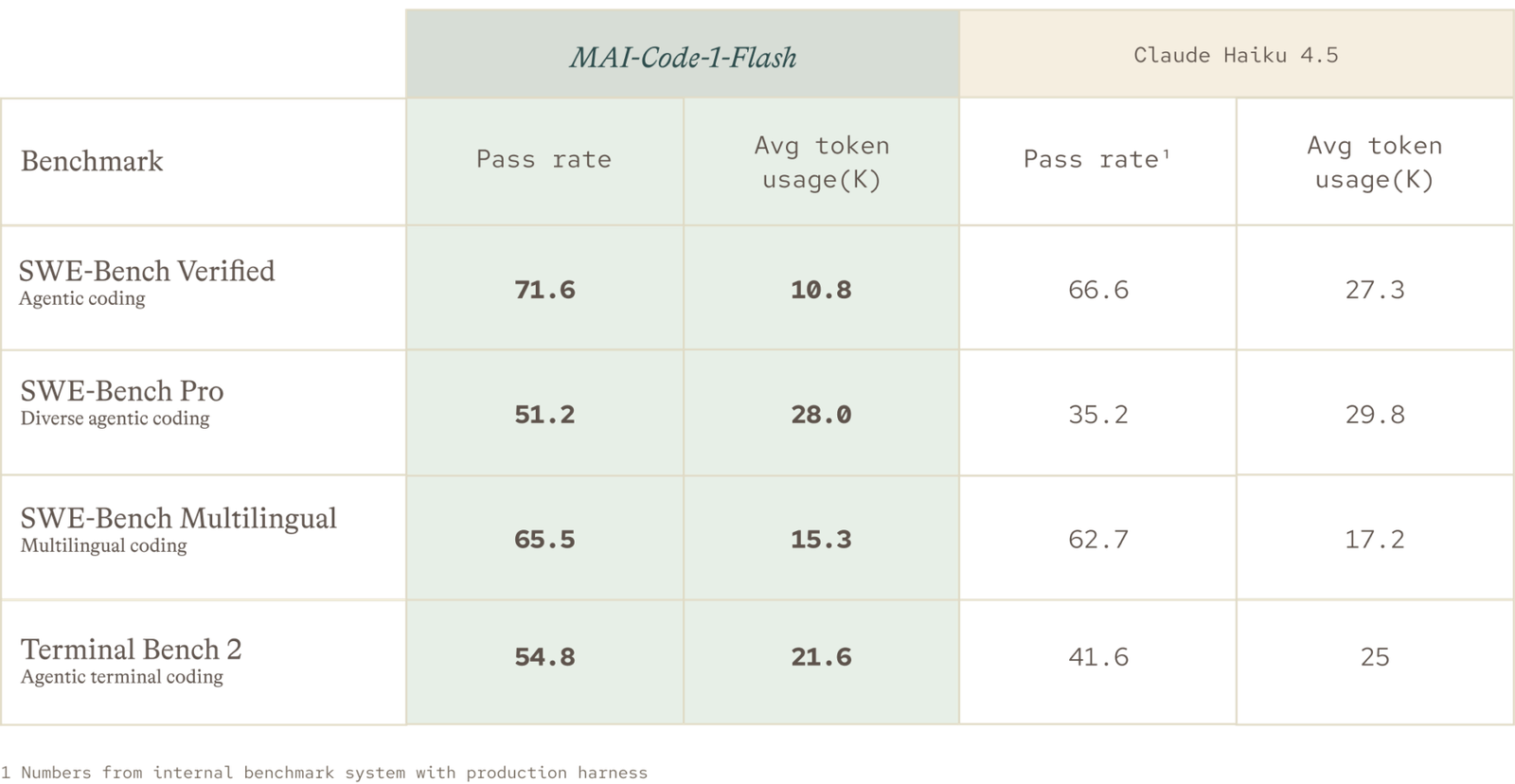
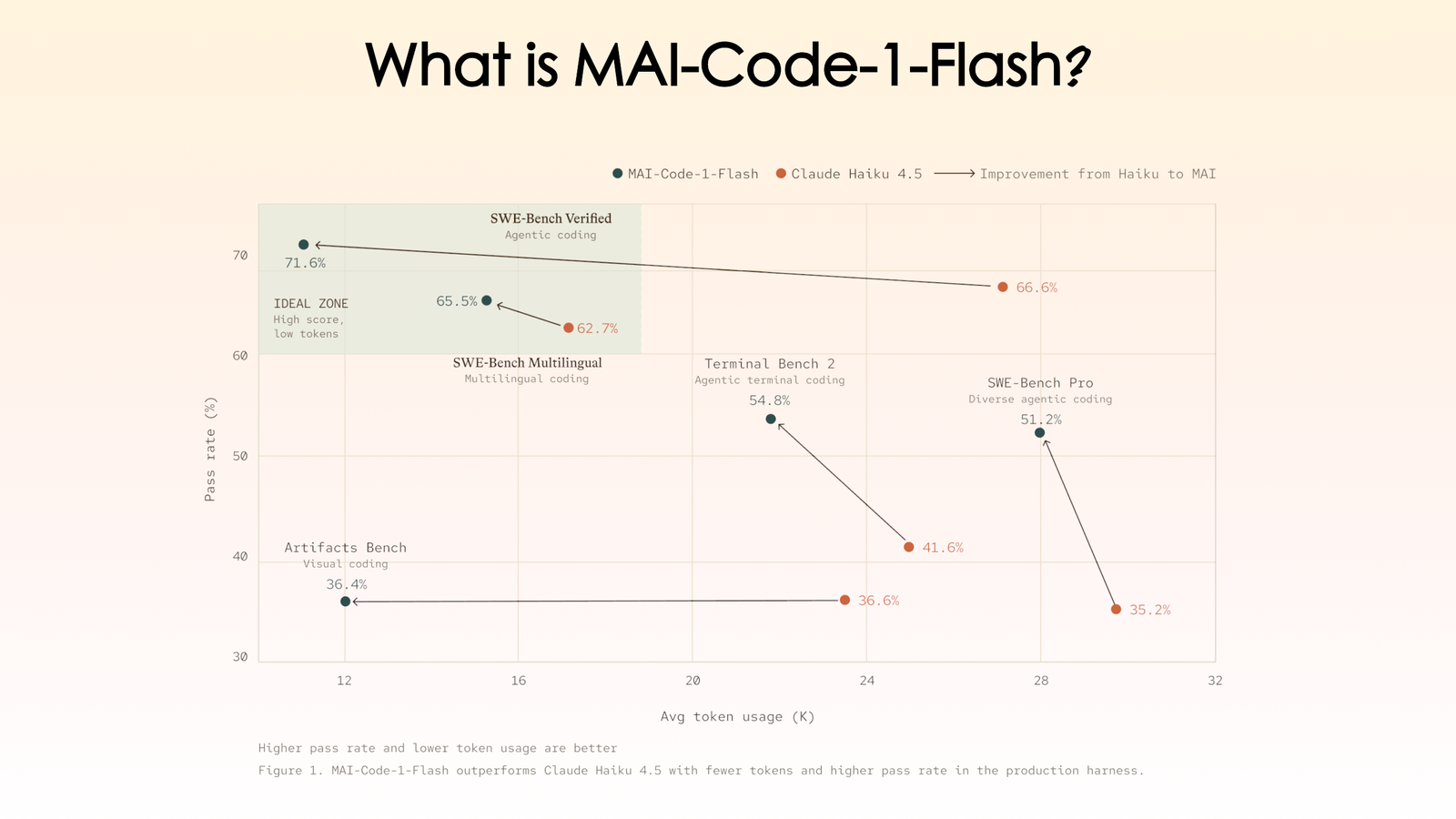
MAI-Code-1-Flash is Microsoft’s purpose-built code generation model. It accepts natural language prompts and returns working source code, targeting the same use cases that GitHub Copilot has dominated: writing functions, scaffolding apps, generating boilerplate, and building out website components. The “Flash” designation signals that it is optimized for speed and cost efficiency rather than maximum capability, which makes it a practical fit for high-frequency developer workflows.
Here is what the model is designed to handle:
- Generating source code from plain-language feature descriptions
- Scaffolding web apps and component trees from a single prompt
- Writing utility functions, API integrations, and data transformation logic
- Filling in boilerplate for common frameworks and patterns
- Supporting iterative development through inline suggestions
Because it is available through Azure AI Foundry, enterprise teams can call it directly via API, integrate it into CI/CD pipelines, or embed it inside internal developer portals. It is not locked to the GitHub Copilot interface, which matters for teams building their own tooling on top of it.
The Full MAI Model Family
Microsoft did not ship one model. It shipped seven. The MAI family covers a range of use cases across text, code, reasoning, vision, and multimodal tasks. This is a deliberate signal that Microsoft intends to compete across the full model capability spectrum, not just fill a gap in one category.
| Model | Primary Purpose | Key Strength |
|---|---|---|
| MAI-Code-1-Flash | Code generation | Natural language to source code, fast and cost-efficient |
| MAI-Thinking-1 | Complex reasoning | Step-by-step reasoning at lower token cost than GPT-5.5 |
| MAI-General-1 | General text tasks | Broad instruction following for enterprise workflows |
| MAI-Vision-1 | Image understanding | Visual reasoning and document analysis |
| MAI-Multimodal-1 | Combined text and image input | Cross-modal tasks in a single API call |
| MAI-Mini-1 | Lightweight inference | Ultra-low latency for simple classification and routing tasks |
| MAI-Embed-1 | Embeddings and retrieval | Semantic search and RAG pipeline optimization |
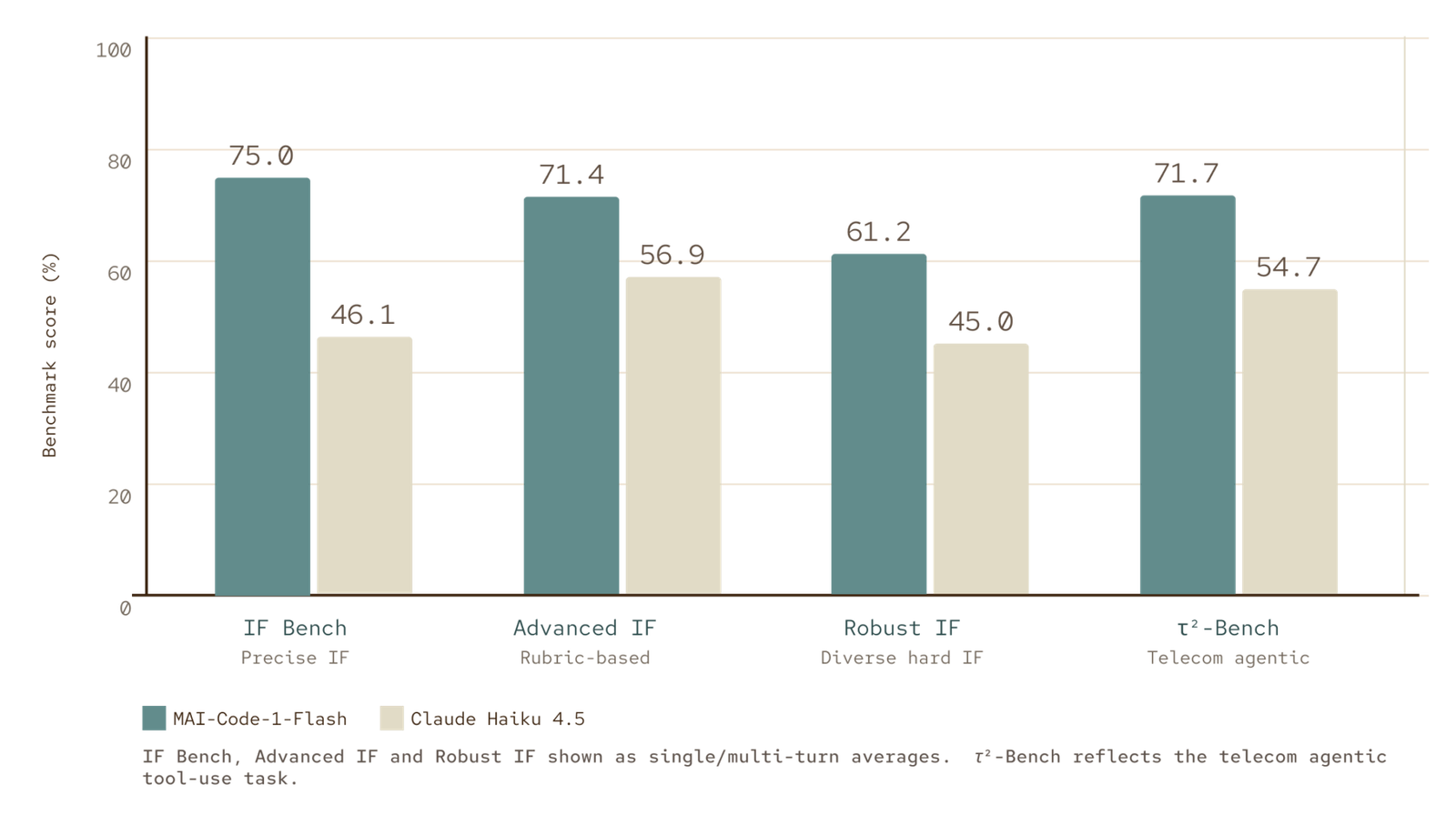
MAI-Thinking-1 deserves a separate callout. Benchmarks released alongside the announcement show it competes with GPT-5.5 and Claude Opus 4.8 on complex reasoning tasks while coming in at a significantly lower cost per token. For developers building agentic systems or multi-step reasoning pipelines, that cost difference can be substantial at scale.
Why Microsoft Is Building Its Own AI
The honest answer is pricing leverage. Microsoft’s $13 billion investment in OpenAI gave it early access to GPT models and a strong enterprise story, but it did not give Microsoft control over what those models cost. Every GitHub Copilot seat, every Azure OpenAI API call, every Copilot for Microsoft 365 license runs on pricing that Microsoft negotiates with a partner rather than sets itself.
That dynamic becomes a problem as Microsoft tries to compete aggressively on AI product pricing. GitHub Copilot moved to usage-based billing on June 1, just one day before Microsoft Build. If Microsoft eventually powers Copilot with MAI-Code-1-Flash instead of OpenAI models, the cost structure of that product changes entirely. Microsoft would control both the model and the developer tool, giving it room to price competitively in a way it currently cannot.
The competitive alignment CNBC identified is also real. Google announced a $100 per month AI developer subscription tier at Google I/O, targeting the same professional developer audience Microsoft is after. Both companies are investing heavily in proprietary model infrastructure. Anthropic and OpenAI, by contrast, remain pure model providers without the distribution advantages that come from owning operating systems, cloud platforms, and developer tools. The MAI launch is Microsoft asserting that it intends to compete at the model layer, not just the application layer.
MAI-Code-1-Flash vs Claude Code vs GitHub Copilot
Developers evaluating MAI-Code-1-Flash will naturally compare it to the tools they already use. Here is how it stacks up against two of the most relevant alternatives right now:
| Factor | MAI-Code-1-Flash | Claude Code | GitHub Copilot |
|---|---|---|---|
| Underlying model | Microsoft MAI (proprietary) | Anthropic Claude Opus / Sonnet | OpenAI models (historically) |
| Primary interface | Azure AI Foundry API | CLI and API | IDE extensions, CLI |
| Pricing model | Usage-based via Azure | Usage-based per token | Seat-based or usage-based (post June 1) |
| Best for | Azure-native teams, cost-sensitive high-volume workflows | Complex multi-file refactors, agentic coding tasks | Inline autocomplete, everyday coding assistance |
| Context window | Not yet disclosed publicly | 200K tokens | Varies by underlying model |
| Enterprise controls | Full Azure compliance stack | Limited enterprise features currently | GitHub org-level controls |
The honest take: MAI-Code-1-Flash is not positioned to replace Claude Code for heavy agentic tasks right now. Claude Code’s large context window and multi-file reasoning give it an edge on complex refactors. But for teams that are already deeply in the Azure ecosystem and want a cheaper, faster model for high-frequency code generation, MAI-Code-1-Flash is a compelling option to test.
How to Access MAI-Code-1-Flash
MAI-Code-1-Flash is available through Azure AI Foundry, Microsoft’s unified platform for deploying and managing AI models. If your team already uses Azure, the path to access is straightforward:
- Navigate to Azure AI Foundry in your Azure portal and search for MAI-Code-1-Flash in the model catalog
- Deploy the model to a managed endpoint in your preferred Azure region
- Call it via the standard Azure AI Inference API, which uses a consistent format across all MAI models
- Set usage limits and monitor token consumption through Azure Monitor and Cost Management
- Apply Azure’s existing compliance controls, including private endpoints, VNET integration, and managed identity auth
Pricing specifics for MAI-Code-1-Flash follow Azure’s pay-per-token model, billed per million input and output tokens. Microsoft has not published a full public pricing page for the MAI family as of this writing, but Azure AI Foundry’s pricing calculator will show live rates once the model is selected for deployment. Expect it to be positioned below GPT-4o pricing, which is part of the competitive pitch.
For teams not yet on Azure, this is a meaningful consideration. The MAI models are Azure-native and are not available through other cloud providers or as standalone API products. If cost is the primary motivation for evaluating MAI-Code-1-Flash, the Azure infrastructure cost should factor into the total comparison against alternatives that run on other platforms.
What This Means for Your Workflow
The practical implications depend on where you sit. Here is a quick breakdown by role and context:
- Azure-first teams: MAI-Code-1-Flash is worth testing immediately. The API format is consistent with other Azure AI models, so integration lift is low. Run a cost comparison against your current OpenAI or Copilot spend after a two-week trial.
- GitHub Copilot users: Nothing changes in your day-to-day workflow right now. But watch for announcements about which models power Copilot’s backend. If Microsoft migrates Copilot to MAI models, usage-based pricing could get cheaper for high-volume users.
- Teams using Claude Code or Cursor: MAI-Code-1-Flash is a different category for now. It excels at fast, high-frequency code generation. It is not a replacement for tools built around large context and multi-file reasoning. Consider it as a complementary option for specific, well-scoped tasks.
- Platform and DevOps engineers: The Azure AI Foundry deployment model means MAI-Code-1-Flash can be embedded in internal developer tools, PR automation, and CI pipelines without leaving your existing Azure security perimeter.
- Startups on tight budgets: The “Flash” tier is designed for cost efficiency. If you are currently paying for GPT-4o-level capability but mostly using it for straightforward code generation, MAI-Code-1-Flash could cut that line item significantly.
Wrapping Up
MAI-Code-1-Flash is not Microsoft’s moonshot moment. It is something more practical: a signal that the company is serious about owning more of its own AI stack, and a useful tool for developers who want a fast, Azure-native code generation model with enterprise compliance baked in.
The bigger story is the strategic shift happening underneath it. Microsoft is building the infrastructure to price its AI products independently of OpenAI. GitHub Copilot, Azure AI services, and eventually Microsoft 365 Copilot could all run on MAI models, giving Microsoft margin control it does not have today. That transition will take time, but the foundation is now in place.
For developers, the near-term action is straightforward. If your team runs on Azure, pull MAI-Code-1-Flash into a test environment and run it against your actual workloads. Token-for-token comparisons with your current tooling will tell you more than any benchmark. The model family is new, the ecosystem is still forming, and the teams that start experimenting now will be better positioned when Microsoft tightens the integration between MAI models and its developer tools.