
Claude Sonnet 5 launched June 30. Claude Fable 5 came back from a 19-day government-ordered shutdown on July 1. Back-to-back. Both are available right now, and the cost gap between them is 5x at current pricing. The benchmark gap on SWE-Bench Pro is 17.1 points. That combination makes this the most consequential model decision Anthropic users face today: absorb the premium for Fable 5 or stay with Sonnet 5, which proves to be the strongest mid-tier coding model on the market.
I’ll help you make that decision in this direct Claude Sonnet 5 vs. Fable 5 coding comparison.
Claude Sonnet 5 vs Claude Fable 5 — Overview
| </> | Sonnet 5 (intro, to Aug 31) | Sonnet 5 (standard, Sep 1+) | Fable 5 |
|---|---|---|---|
| Input per 1M tokens | $2 | $3 | $10 |
| Output per 1M tokens | $10 | $15 | $50 |
| Cost multiple vs Sonnet 5 intro | 1x | 1x | 5x input, 5x output |
| Cost multiple vs Sonnet 5 standard | — | 1x | 3.3x input, 3.3x output |
| Context window | 1,000,000 tokens | 1,000,000 tokens | 1M+ tokens |
| Max output | 128,000 tokens | 128,000 tokens | Not published separately |
| Speed | 84.8 tok/s | 84.8 tok/s | Slower (not published) |
| Time to first token | 150.6s | 150.6s | Higher |
| Default model | Yes (Free and Pro) | Yes (Free and Pro) | No — requires explicit selection |
| Availability | All plans, all major IDEs | All plans, all major IDEs | Now, 50% usage cap until Jul 7 |
| Released | June 30, 2026 | June 30, 2026 | June 9, restored July 1, 2026 |
Sonnet 5 is available on Claude.ai, Claude Code, AWS Bedrock, Google Cloud, and GitHub Copilot across all tiers. Fable 5 is available via the API and Claude.ai with explicit model selection, but carries a 50% usage cap through July 7. The restricted Mythos 5 variant remains gated to approved US organisations through Project Glasswing and is not part of this comparison.
The Benchmark Gap: Where Fable 5 Leads
| Benchmark | Sonnet 5 | Fable 5 | Gap |
|---|---|---|---|
| SWE-Bench Verified | 85.2% | 95.0% | Fable 5 +9.8 pts |
| SWE-Bench Pro | 63.2% | 80.3% | Fable 5 +17.1 pts |
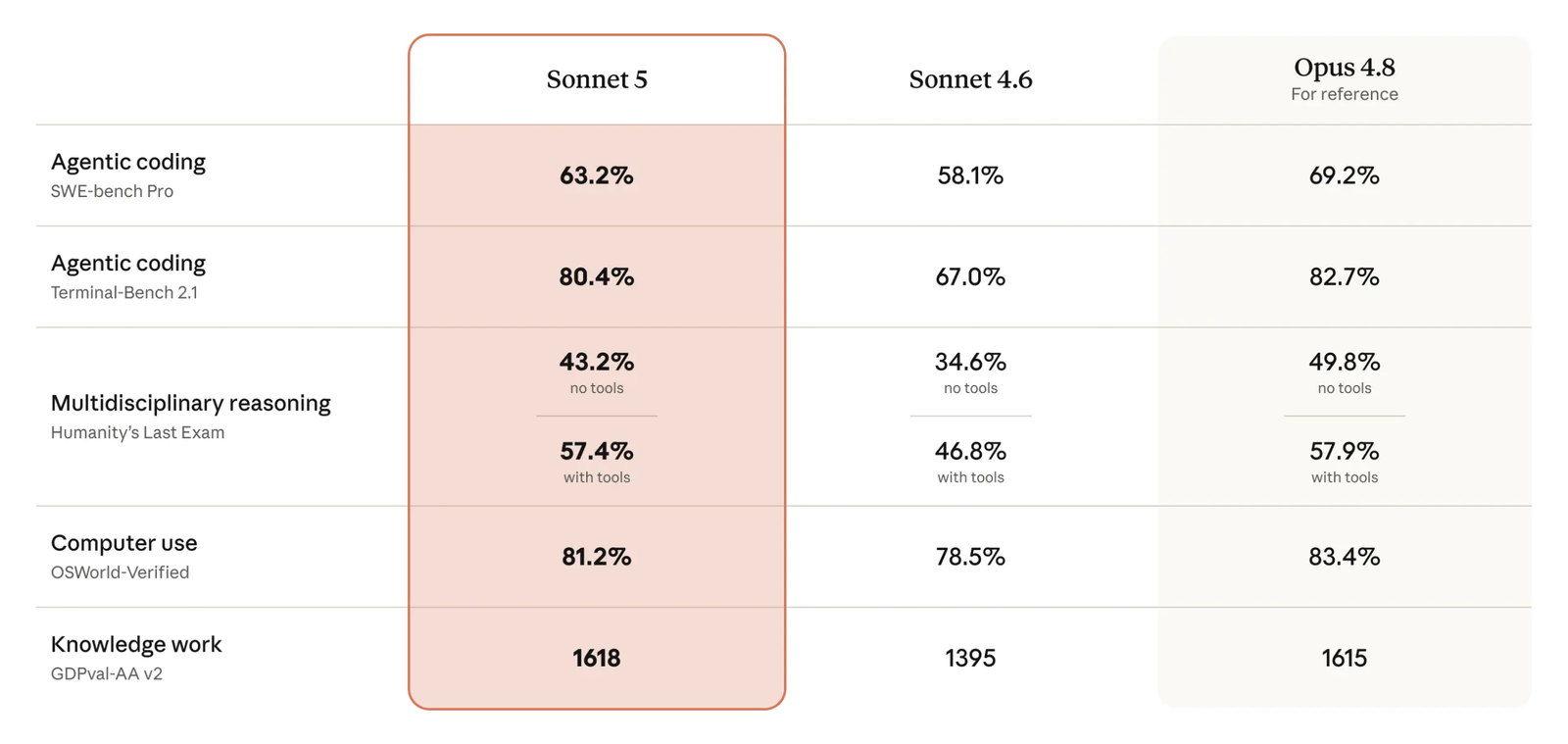
| Terminal-Bench 2.1 | 80.4% | 84.3% | Fable 5 +3.9 pts |
| HLE with tools | 57.4% | 64.5% | Fable 5 +7.1 pts |
| HLE without tools | 43.2% | 59.0% | Fable 5 +15.8 pts |
| GPQA Diamond | Not published | 94.1% | — |
| USAMO 2026 | 79.5% | Higher (est.) | Fable 5 leads |
| GDPval-AA Elo | 1618 | 1932 | Fable 5 +314 pts |
| Artificial Analysis Index | 53.35 (#5 of 161) | Not yet ranked | — |
| BenchLM.ai ranking | Not yet ranked | #1 of 124 (provisional) | — |
The SWE-Bench Pro gap deserves more attention than the headline number suggests. SWE-Bench Pro uses real production repositories with real issue reports, not the curated subset that SWE-Bench Verified draws from. A 17.1-point gap at this level of benchmark difficulty means Fable 5 resolves roughly one in four more issues than Sonnet 5 on the hardest class of agentic coding tasks. That is not a marginal improvement. It is a different capability tier.
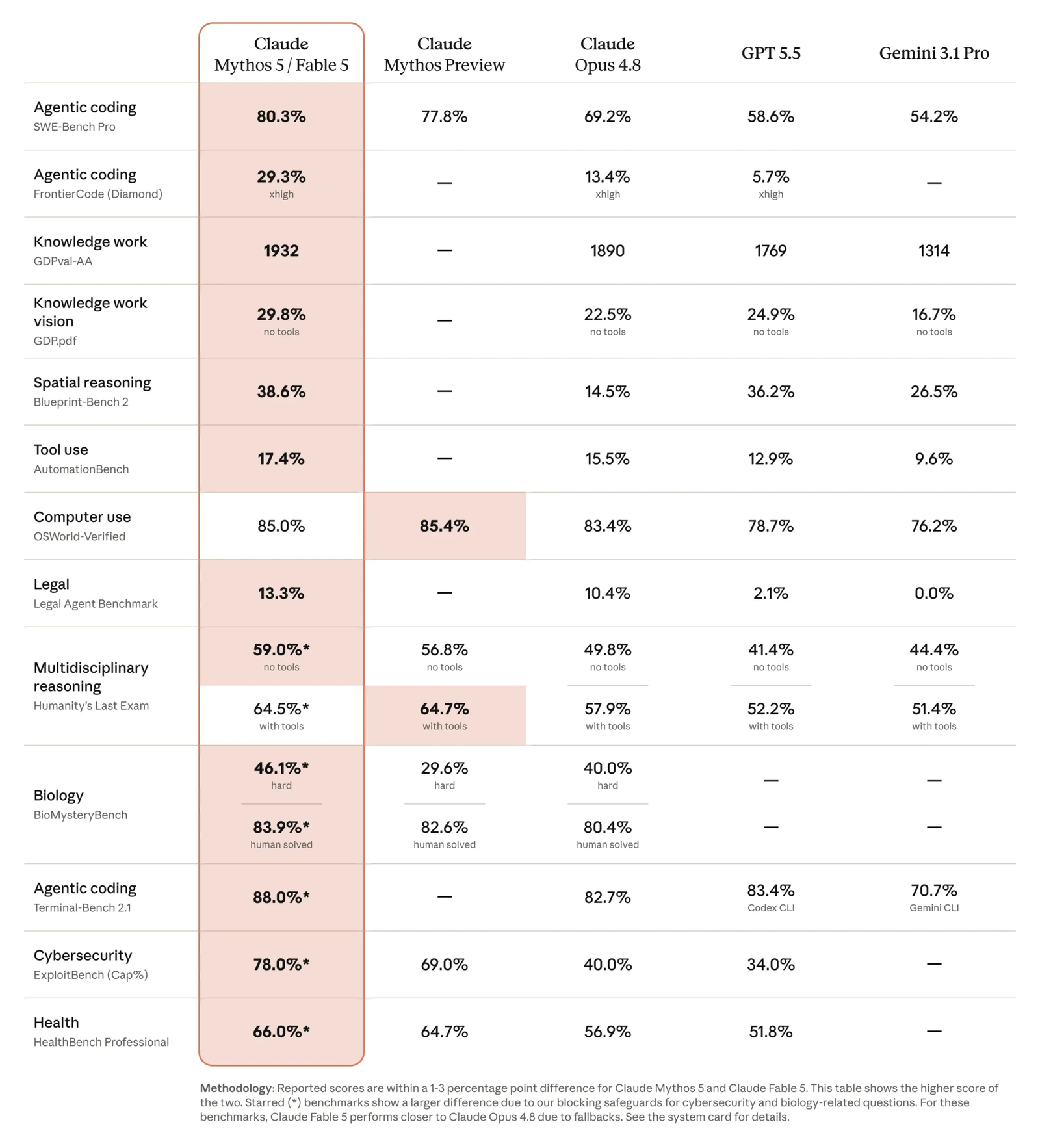
The deep reasoning gap reinforces this. On Humanity’s Last Exam without tool access, Fable 5 scores 59.0% against Sonnet 5’s 43.2%. A 15.8-point gap on reasoning without external lookup matters specifically for coding tasks where the model cannot run the code, cannot search documentation, and must reason through architectural decisions from first principles. Multi-file refactors, subtle concurrency bugs, and ambiguous API design choices all fall into this category.
The Elo gap of 314 points on GDPval-AA is also significant. Elo differences at this scale indicate consistent dominance across task variety, not a narrow specialisation. Fable 5 at 1932 versus Sonnet 5 at 1618 is the difference between a model that handles the long tail of unusual coding problems and one that handles the common case well.
Where Sonnet 5 Holds Its Own
The gap is real, but it is not uniform. For a significant share of everyday coding work, Sonnet 5 is the rational choice.
- Terminal-Bench 2.1: only 3.9 points behind. For CLI scripting, shell automation, and DevOps tooling, Sonnet 5’s 80.4% is genuinely strong. The gap here does not justify a 5x cost premium for teams whose workload skews toward terminal tasks.
- Single-file and small-scope changes. Sonnet 5’s 85.2% SWE-Bench Verified score places it among the best models available. Most day-to-day coding tasks — adding a function, fixing a regression, writing a test — do not approach the complexity ceiling where Fable 5’s advantage emerges.
- High-frequency agentic workflows. If your pipeline runs hundreds of API calls per day, the 5x cost difference is the entire budget conversation. At $2 input per 1M tokens (intro pricing), Sonnet 5 lets you run five times the volume for the same spend.
- Speed-sensitive applications. Sonnet 5 generates at 84.8 tokens per second. Fable 5’s generation speed is slower and not independently published. For real-time or interactive coding assistants, latency compounds at scale.
- GitHub Copilot users. Sonnet 5 is the default model across all Copilot tiers. There is no additional configuration required, and no usage cap to navigate.
- IDE integrations. Sonnet 5 ships as the default in all major IDEs through Claude Code and Copilot. Fable 5 requires explicit selection and is not the default anywhere.
The Fable 5 Elephant in the Room: 19 Days Offline
Fable 5 launched on June 9, 2026. Three days later, on June 12, the US government issued an export control directive that forced Anthropic to suspend access worldwide. The model was offline for 19 days before being restored on July 1. That sequence is now a documented part of Fable 5’s production history, and it raises questions that benchmark scores cannot answer.
The restoration came with two attached conditions. First, Anthropic deployed a new safety classifier designed to block the jailbreak exploit that was reportedly central to the government’s concern. The classifier blocks the reported attack vector in over 99% of cases. Second, a 50% usage cap applies through July 7, after which usage-based credits take effect. Teams that planned to migrate workloads to Fable 5 before the shutdown hit a wall on June 12 and now face a throttled ramp-back period.
The new safety classifier also introduces a practical consideration for security-adjacent code. Fable 5 already holds an ExploitBench score of 78.0% (Mythos variant). With the new classifier active, prompts involving vulnerability detection, penetration testing tooling, or exploit analysis may behave differently than they did before the shutdown. Teams relying on Fable 5 for security-adjacent work should validate their existing prompts against the new classifier before committing to production use.
The honest production reliability question is this: Sonnet 5 has been available without interruption since June 30. Fable 5 has been available for three days, then offline for nineteen, then back with a usage cap. For any organisation where model availability is a hard dependency, that history is a legitimate factor in the evaluation.
Claude Sonnet 5 vs Claude Fable 5: Pricing Comparison
The pricing tables show 5x input and 5x output. What does that look like in practice for a typical agentic coding workload?
Artificial Analysis measures cost per task across standardised workloads. For Sonnet 5, that figure comes to $2.29 per task at standard pricing (from September 1). That number already reflects Sonnet 5’s new tokenizer, which produces 27 to 42 percent more tokens for the same text compared to previous Claude tokenizers. In plain terms: the $3 input price understates the real cost for English-heavy code and documentation by that margin. A task that cost $1.20 on Sonnet 4.6 now costs $2.29 on Sonnet 5 at standard pricing.
For Fable 5, an independent per-task cost measurement is not yet published. Based on the $10 input / $50 output pricing and typical model verbosity at this capability tier, the estimated range is $4 to $6 per comparable task. That estimate will firm up as usage data accumulates after the July 1 restoration.
- Sonnet 5 intro pricing (to Aug 31): $2.29 per AA task (includes tokenizer inflation)
- Sonnet 5 standard pricing (from Sep 1): Higher by 50% on input and output rates
- Fable 5: Estimated $4-6 per comparable task; 5x the intro input price, 3.3x the standard input price
- Break-even scenario: If Fable 5 resolves issues that Sonnet 5 cannot, and those issues would otherwise require human engineering time, the premium pays for itself. If the workload sits within Sonnet 5’s capability range, the premium is pure overhead.
One additional note on the Sonnet 5 tokenizer change. The 27 to 42 percent inflation applies most heavily to prose-heavy inputs, mixed code-and-comment files, and documentation. Pure code with minimal comments is less affected. Teams with high documentation-to-code ratios should test their actual token counts before projecting costs from the headline pricing.
Claude Sonnet 5 vs Claude Fable 5: Which Is Better for Your Coding Use Case?
| Use Case | Sonnet 5 | Fable 5 | Recommendation |
|---|---|---|---|
| High-volume agentic pipelines (100+ calls/day) | $2.29/task (intro) | Est. $4-6/task | Sonnet 5 — cost difference dominates |
| Complex multi-file refactors | 63.2% SWE-Bench Pro | 80.3% SWE-Bench Pro | Fable 5 — 17.1-point gap is decisive |
| Single-file bug fixes and feature additions | 85.2% SWE-Bench Verified | 95.0% SWE-Bench Verified | Sonnet 5 — strong enough for most cases |
| CLI and shell automation | 80.4% Terminal-Bench | 84.3% Terminal-Bench | Sonnet 5 — 3.9-point gap does not justify 5x cost |
| Deep architectural reasoning (no tool access) | 43.2% HLE no tools | 59.0% HLE no tools | Fable 5 — 15.8-point gap matters here |
| Security-adjacent code analysis | No ExploitBench score published | 78.0% ExploitBench (Mythos) | Fable 5 — validate prompts post-classifier update |
| Real-time / interactive coding assistant | 84.8 tok/s, known latency | Slower, latency not published | Sonnet 5 — speed and predictability win |
| GitHub Copilot workflow | Default across all tiers | Not available as Copilot default | Sonnet 5 — zero-friction access |
| Production reliability requirement | Available since Jun 30, no interruption | 19-day outage, restored Jul 1, cap until Jul 7 | Sonnet 5 — track record is shorter but uninterrupted |
| Hard problems, long tail of unusual issues | GDPval-AA Elo: 1618 | GDPval-AA Elo: 1932 | Fable 5 — 314 Elo gap reflects consistent advantage |
The Bottom Line
Claude Sonnet 5 vs Claude Fable 5 is not a close call on benchmarks, but it is a close call on value. Fable 5 is the stronger coding model by a meaningful margin, especially on the hardest agentic tasks, where the 17.1-point SWE-Bench Pro gap and the 314-point Elo differential reflect real capability differences. If your team regularly hits the ceiling on complex multi-file work or deep reasoning without tool access, Fable 5 earns its premium. For everything else — high-volume pipelines, terminal tasks, single-file changes, speed-sensitive workflows, and any use case where production reliability history matters — Sonnet 5 is the rational default. It is also the literal default, which means zero friction and no usage cap to manage. Wait until Fable 5’s post-restoration reliability data accumulates and the July 7 usage cap lifts before treating it as a production foundation.