Amazon’s Kiro and Cursor (Cursor ‘3’) are two of the most popular AI-powered IDEs among developers. Where Cursor is optimized for speed (parallel agents, a proprietary model, snappy results), Kiro is optimized for correctness: no code gets written until you have a spec. Both start at $20 a month. Both are genuinely good. But in 2026, the right choice depends entirely on how your team builds software.
Our Kiro vs Cursor comparison is built on benchmark data, pricing breakdowns, production test reports, and developer community sentiment from Reddit, Hacker News, and LogRocket’s June 2026 AI dev tool rankings. By the end, you will have a clear picture of where each tool wins and loses, and which one earns its seat in your workflow.
Quick Comparison: Kiro vs Cursor at a Glance
| Factor | Cursor 3 | Amazon Kiro |
|---|---|---|
| Launch | Cursor 3: April 2, 2026 | July 14, 2025 |
| Starting price | Free (limited) / Pro $20/mo | Free (50 requests/mo) / Pro $20/mo |
| Mid tier | Pro+ $60/mo | Pro+ $40/mo |
| Top tier | Ultra $200/mo | Power $200/mo |
| Primary model | Composer 2.5 + multi-model | Claude Sonnet 4.6 via Bedrock |
| Coding benchmark | 0.751 (with Claude Opus 4.6) | Above 0.69 |
| Composer 2.5 SWE-Bench | 79.8% Multilingual | N/A (no proprietary model) |
| Parallel agents | Up to 8 simultaneously | Sequential spec phases |
| Browser preview | Yes, integrated | No |
| AWS-native | No | Yes (Lambda, CDK, CloudFormation) |
| GovCloud available | No | Yes (US-East + US-West, Feb 2026) |
| FedRAMP path | No | Pursuing High + DoD CC SRG |
| Free tier without account | No | Yes, no card or AWS account needed |
| ARR | $2B+ projection | Not disclosed (AWS product) |
What Is Kiro? The Spec-First IDE Explained
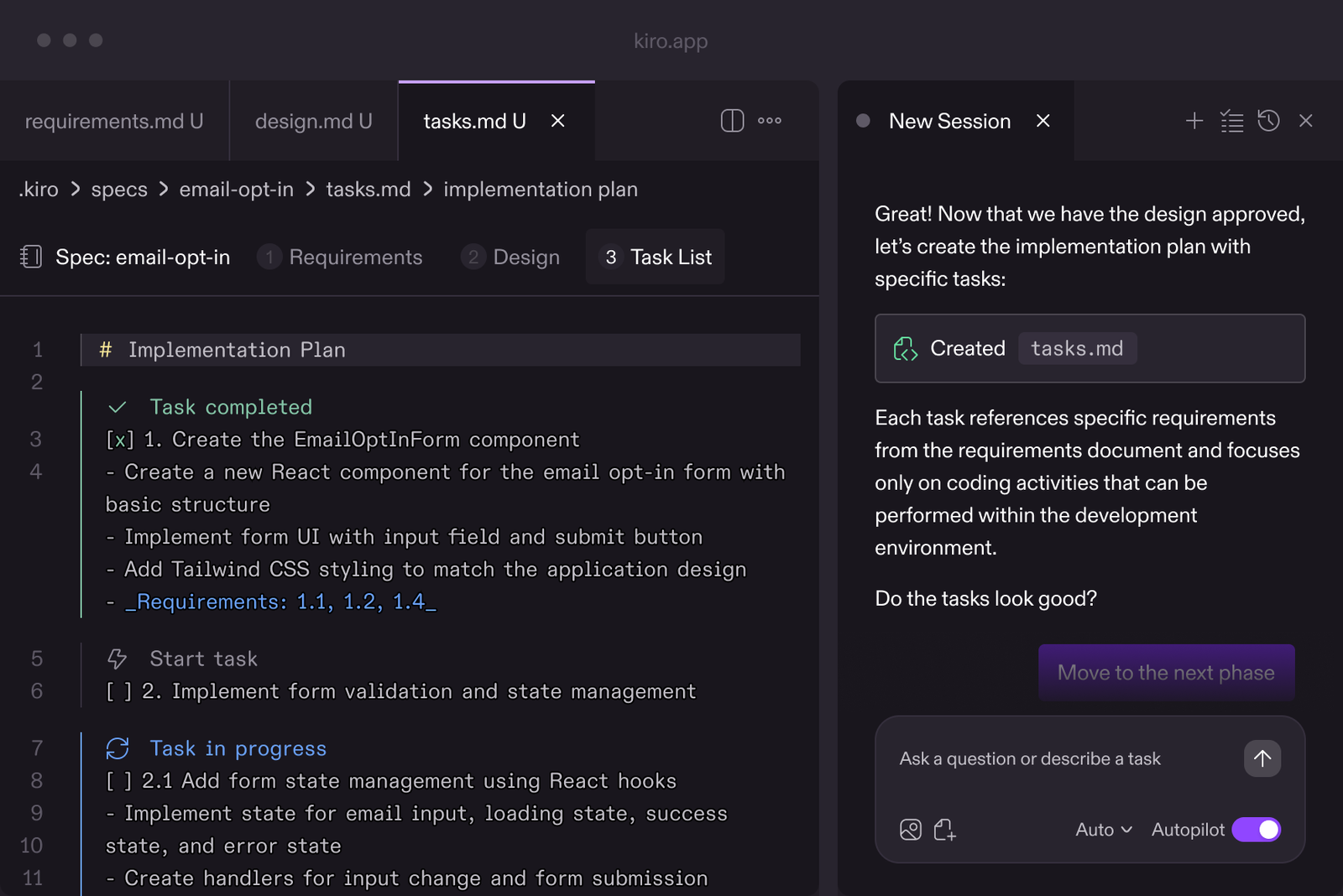
Amazon Kiro launched on July 14, 2025, with a clear thesis: AI coding tools are fast but undisciplined. They write code immediately, confidently, and sometimes completely wrong. Kiro’s answer is to enforce structured thinking before any code is generated.
Every Kiro session starts with three sequential phases, and you cannot skip them:
- requirements.md — Kiro works with you to articulate what needs to be built. Functional requirements, edge cases, user stories. In plain language.
- design.md — Architecture decisions, component breakdown, data models, API contracts. The agent reasons through the system before touching a file.
- tasks.md — A sequenced, dependency-aware implementation plan the agent follows step by step.
Only once all three documents exist does Kiro generate a single line of code. For teams that have spent hours reviewing AI-generated code that solved the wrong problem, this feels like a fundamentally different tool.
Kiro runs on Claude Sonnet 4.6 via Amazon Bedrock by default, with Claude 3.7 as a fallback. It has no proprietary model, but it has something arguably more valuable for certain teams: native AWS comprehension. Kiro understands Lambda functions, CDK constructs, CloudFormation templates, and CodeCatalyst workflows without any additional configuration. On an AWS-native stack, this is not a marginal convenience. It is a meaningful speed advantage.
Kiro also supports Agent hooks and MCP servers, which lets teams extend its capabilities with custom tooling. Multi-agent swarms are possible, though they require more deliberate configuration than Cursor’s parallel agents.
GovCloud and compliance: As of February 2026, Kiro is the only mainstream AI IDE available in AWS GovCloud (US-East and US-West). It supports private endpoints over VPN and Direct Connect, enterprise authentication via IAM Identity Center, and is actively pursuing FedRAMP High and DoD CC SRG authorization. No other AI coding tool is on this compliance path.
What Is Cursor 3? The Agent-First Rebuild
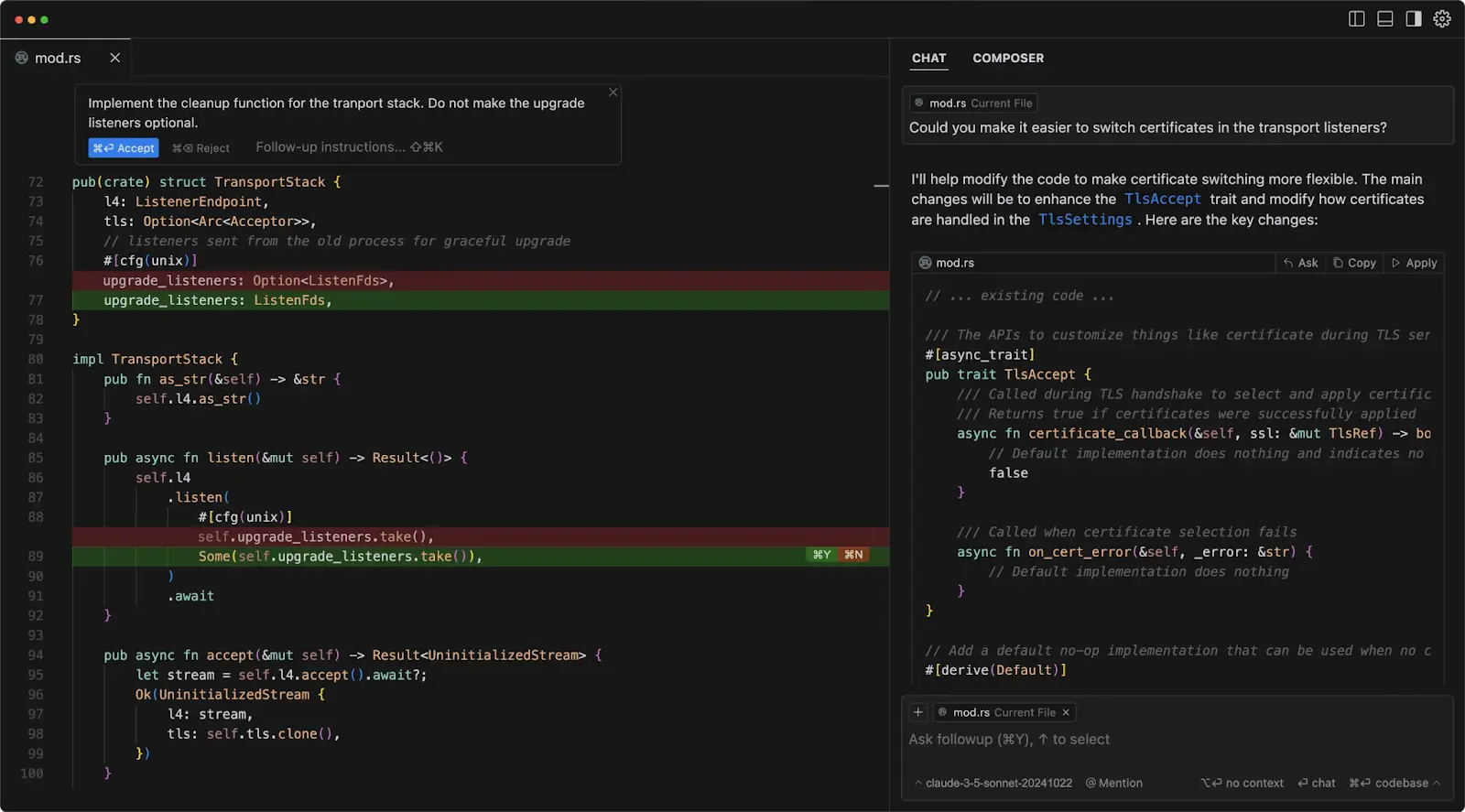
Cursor 3 launched on April 2, 2026, as a ground-up rebuild of what had already become the dominant AI IDE on the market. The rebuild centered on one capability: true parallelism. Cursor 3 can run up to 8 background agents simultaneously, each working on independent tasks, with results returning in under 30 seconds.
For context on what this means in practice: a developer can queue a list of eight discrete tasks, switch to another window, and return to completed diffs. On the right kind of work, it compresses hours into minutes.
Cursor 3 also ships with Composer 2.5, the platform’s own proprietary model. Composer 2.5 is built on a Kimi K2.5 base with a 4x-scale reinforcement learning run on top. The result: 79.8% on SWE-Bench Multilingual and 63.2% on CursorBench v3.1, with performance comparable to Claude Opus 4.7 at roughly one-tenth the token cost. At $0.50/$2.50 per million tokens input/output, Composer 2.5 is one of the most cost-efficient frontier-grade coding models available.
The other capability Kiro simply does not have: integrated browser preview. Cursor’s AI can see your rendered output, identify visual bugs, and iterate on UI without you describing what is wrong. For frontend developers, this is not a nice-to-have. It fundamentally changes how quickly you can ship polished interfaces.
Cursor supports Claude, GPT-5, Gemini, and Composer 2.5, giving teams the flexibility to choose the right model for each task. Its ARR is on track for a $2B+ projection, with broad adoption across solo developers, startups, and enterprise engineering teams.
Benchmark Breakdown: Cursor 0.751, Kiro 0.69+
The most rigorous head-to-head data comes from the combined AI coding benchmark dataset tracked by LogRocket and others in their June 2026 AI dev tool power rankings. Cursor 3 with Claude Opus 4.6 scores 0.751, the highest published score in the field. Kiro scores above 0.69 on the same dataset. That 0.06+ gap is real but not enormous, especially given how different the two tools are in approach.
Composer 2.5’s specific benchmark results are worth examining separately:
| Benchmark | Composer 2.5 | Claude Opus 4.7 (reference) |
|---|---|---|
| SWE-Bench Multilingual | 79.8% | ~80% |
| CursorBench v3.1 | 63.2% | ~63% |
| Cost per 1M input tokens | $0.50 | ~$5.00 |
| Cost per 1M output tokens | $2.50 | ~$25.00 |
The cost-to-performance ratio here is the most important number in the table. Composer 2.5 delivers near-identical benchmark scores at roughly one-tenth the cost of Claude Opus 4.7. For teams running high-volume agentic workflows, the difference between $0.50 and $5.00 per million tokens is not marginal. It is the difference between a sustainable and unsustainable infrastructure cost.
Benchmark caveat: Kiro’s spec-driven workflow changes the cost equation in a different way. By forcing structured thinking upfront, Kiro reduces wasted generation. In Augment Code’s production test of both tools on a real feature, Kiro produced fewer total tokens of throwaway code. Benchmark scores measure raw task completion. They do not measure how much generated code you actually keep.
The Hidden Cost Nobody Talks About: Rework
Speed benchmarks tell you how fast an AI IDE generates code. They do not tell you how much of that code survives code review.
This is the core tension in the Kiro vs Cursor debate. Cursor generates faster. Kiro generates with more upfront alignment. The question for your team is: which failure mode costs you more time?
Developers on r/cursor and r/ExperiencedDevs have been documenting this trade-off through 2026. A representative thread on r/ExperiencedDevs from April 2026 put it plainly: “Cursor with 8 parallel agents is incredible for greenfield work where direction is clear. The moment you have a complex domain or legacy context, the spec-first approach saves you from an afternoon of undoing confident wrong answers.” The thread accumulated over 340 upvotes and is frequently cited in comparisons.
On the other side, a Hacker News discussion from May 2026 around Kiro’s GovCloud announcement included this high-voted comment: “The three-phase spec workflow is exactly right for enterprise use cases where the cost of a wrong architectural decision is measured in weeks, not hours. For my side projects, I still reach for Cursor because I can iterate faster than I can spec.”
Neither view is wrong. They reflect genuinely different use cases, and both communities are large enough that the comparison is live, active, and worth reading directly before you decide.
What Developers Are Actually Saying in 2026
Community sentiment has converged around a few consistent themes. Here is what the data from developer forums shows as of June 2026:
On Reddit (r/cursor, r/ExperiencedDevs, r/aws):
- Cursor dominates for frontend and rapid prototyping. The browser preview feature is consistently cited as the most underrated capability in AI IDEs, especially for React and Next.js developers.
- Kiro gets the strongest praise from AWS backend teams. Threads on r/aws from early 2026 report Kiro correctly scaffolding Lambda + API Gateway + DynamoDB patterns on the first pass, where generic AI tools require multiple correction cycles.
- Solo developers report using Cursor as their primary daily driver and adding Kiro specifically for migration and refactor work. This pattern appears in enough threads to constitute a genuine workflow norm.
On Hacker News:
- The Kiro GovCloud announcement thread (May 2026) generated significant discussion, with engineers from regulated industries noting it as the first time an AI IDE became a serious procurement option for their organizations.
- Cursor 3’s launch post was broadly positive, with top comments focusing on the Composer 2.5 cost efficiency rather than the speed improvements. The consensus: the benchmark-to-cost ratio is genuinely novel.
- Multiple threads discuss the layered workflow pattern as an emerging best practice, with both tools in the stack rather than a single winner.
From LogRocket’s June 2026 AI dev tool power rankings: Cursor holds the top position overall in developer satisfaction scores. Kiro ranks higher in enterprise-specific satisfaction metrics, particularly among teams with compliance requirements and AWS-heavy infrastructure. The report notes that the two tools are increasingly seen as complementary rather than competing.
Kiro vs Cursor 2026 Pricing Compared: Every Tier Explained
| Tier | Cursor | Kiro |
|---|---|---|
| Free | Limited, no permanent agentic free tier | 50 agentic requests/mo, no credit card, no AWS account |
| Pro | $20/mo — multi-model, standard agent credits | $20/mo — 225 vibe requests + 125 spec requests |
| Mid tier | $60/mo (Pro+) | $40/mo (Pro+) |
| Top tier | $200/mo (Ultra) | $200/mo (Power) |
| Teams | $40/seat/mo | Enterprise via AWS Marketplace |
Three things stand out in this comparison.
First, Kiro’s free tier is meaningfully better. No credit card, no AWS account, 50 agentic requests a month. Cursor’s free tier exists but does not include a permanent allocation of agentic requests. For developers evaluating before committing, Kiro is lower friction to actually test in a real project.
Second, Kiro fills a pricing gap that Cursor leaves open. Cursor jumps from Pro at $20 to Pro+ at $60, a 3x increase with no middle option for individuals. Kiro Pro+ sits at $40. That $20 difference matters for solo developers and early-stage teams who have outgrown the base tier but are not ready for $60.
Third, the $40/seat Teams tier from Cursor is competitive for organizations. Kiro’s enterprise pricing routes through AWS Marketplace, which adds procurement flexibility for companies already running AWS consolidated billing but makes it harder to compare directly on price.
When Kiro Is the Right Choice
- Your infrastructure runs on AWS — native Lambda, CDK, CloudFormation, and CodeCatalyst comprehension is not something you can replicate with prompt engineering in Cursor
- You work in a regulated industry — federal agencies, defense contractors, healthcare organizations, and financial institutions need GovCloud, FedRAMP, and IAM Identity Center; Kiro is currently the only AI IDE that can clear those requirements
- Your team generates a lot of throwaway AI code — the spec-first workflow forces alignment before generation and measurably reduces the volume of code that fails review
- You are tackling a large architectural project — migrations, multi-service refactors, and greenfield systems with complex domain requirements benefit from the structured planning Kiro enforces
- You want a mid-tier pricing option — Pro+ at $40/month has no equivalent in Cursor’s lineup
- You need low-friction evaluation — Kiro’s free tier requires no commitment and no account beyond an email
When Cursor Is the Right Choice
- You build frontend UI — the integrated browser preview is Cursor’s single most differentiating feature; no other AI IDE lets the agent see rendered output and debug visual issues inline
- Speed is the primary metric — 8 parallel background agents completing tasks in under 30 seconds is genuinely the fastest agentic coding experience available in 2026
- You want model flexibility — Claude, GPT-5, Gemini, and Composer 2.5 are all available; you can switch per task based on cost and capability
- Cost efficiency at high volume matters — Composer 2.5 at $0.50/$2.50 per million tokens is one of the cheapest frontier-grade coding models available, and the savings compound fast on large agentic workloads
- Your stack is not AWS — Kiro’s AWS integration adds no value on GCP, Azure, or custom infrastructure; Cursor works everywhere without configuration
- You work solo with clear direction — when you know exactly what you want built, Cursor’s parallelism and diff views give you the fastest path from idea to running code
A Note on NemoClaw and the Broader Landscape
It is worth briefly acknowledging NVIDIA’s NemoClaw, which launched at GTC 2026 in San Jose. NemoClaw targets the enterprise automation layer above the IDE, with Adobe, Salesforce, SAP, Cisco, and Google as early clients. It is vendor-agnostic and explicitly not GPU-dependent. NemoClaw is less a direct competitor to Cursor or Kiro and more a control plane layer for teams running complex multi-agent enterprise workflows. On the PinchBench evaluation, Nvidia Nemotron-3-Super-120B scores 85.6%, ranking fourth overall. If you are evaluating AI tooling at the enterprise orchestration level rather than the developer IDE level, NemoClaw belongs in your research.
The Layered Workflow: How Most Teams Are Using Both
The dominant pattern that has emerged across developer communities in 2026 is not choosing Cursor or Kiro. It is using both, for different types of work.
Tom’s Guide reported in May 2026 that developers are no longer picking a single AI tool for their workflow. The data from Reddit communities shows a consistent pattern: specialized tools for specialized tasks. In the AI IDE context, this means Cursor for active daily development work and Kiro for the heavier, architecture-level tasks that benefit from structured planning.
A typical layered workflow looks like this:
- Daily feature development, UI work, bug fixes: Cursor, using Composer 2.5 for cost efficiency or Claude Opus 4.6 for maximum quality
- New service scaffolding on AWS: Kiro, using the spec-driven workflow to generate correct CDK/Lambda architecture on the first pass
- Large refactors or migrations: Kiro, with requirements.md and design.md to ensure the refactor plan is sound before generation begins
- Frontend debugging and visual polish: Cursor, using browser preview to close the loop between code and rendered output
The two tools target different phases of the development cycle. Running both does not mean doubling your tooling cost. It means paying $20-40/month for each and using the right one for the right job. Most developers report that the combination saves more time than either tool alone.
Is Kiro better than Cursor?
Neither is categorically better. Cursor leads on raw speed, benchmark scores, browser integration, model flexibility, and adoption scale. Kiro leads on AWS-native tooling, compliance credentials, spec-driven workflow quality, and mid-tier pricing. The right answer depends on your stack, your team’s failure modes, and whether compliance requirements are part of your procurement process.
Does Kiro have a free tier?
Yes. Kiro’s free tier includes 50 agentic requests per month and requires no credit card or AWS account. It is the most accessible free tier among major AI IDEs in 2026, and a genuine way to evaluate the spec-driven workflow on a real project before paying anything.
What model does Kiro use?
Kiro uses Claude Sonnet 4.6 via Amazon Bedrock as its default model, with Claude 3.7 as a backup. It does not ship a proprietary model. Multi-vendor routing is possible via middleware integrations, but Kiro is fundamentally a Claude-powered tool. This makes it a natural fit for teams already using Claude Code or building on Anthropic’s API.
Can you use Cursor and Kiro together?
Yes, and based on developer community reports through mid-2026, many teams do. The tools target different phases of the development workflow and do not conflict. Cursor for active coding and iteration; Kiro for spec-driven planning and AWS-native scaffolding. Both subscriptions together cost between $40 and $80 per month at the Pro tier, which is well within the range most engineering teams budget for developer tooling.
Which AI IDE is best for AWS developers?
Kiro is the strongest choice for AWS-native teams. Its native understanding of Lambda, CDK, CloudFormation, and CodeCatalyst is not replicated by any other AI IDE. For teams in regulated industries that require GovCloud deployment or FedRAMP compliance, Kiro is currently the only viable option in the AI IDE category.
Wrapping Up
Cursor and Kiro are the two most interesting AI IDEs of 2026, and they are interesting in fundamentally different ways. Cursor is faster, more flexible, and better at the visual feedback loop that frontend work demands. Kiro is more structured, more compliant, and more aligned with the way enterprise AWS teams actually want to build.
The developer community has largely stopped debating which one wins. The more useful question is: for which tasks should each one run?
- Try Kiro’s free tier on a real AWS project this week. The 50 free agentic requests require no credit card. Run the spec-driven workflow on a Lambda function or CDK stack you are actively building and compare the output quality to your current tool.
- Test Cursor 3’s parallel agents on a list of independent tasks. Pick 6 to 8 discrete, unrelated improvements to a codebase and queue them all at once. The time compression on that kind of parallelizable work is the clearest demonstration of what Cursor 3 changed.
- Audit your last month of AI-assisted code. How much of what your current tool generated did you actually keep? If the answer is less than 70%, the structured spec workflow in Kiro will likely recover more time than it costs.