Claude Sonnet 5 launched June 30, 2026, and is available to everyone right now. GPT-5.6 Sol launched four days earlier, on June 26, but only around 20 government-approved organisations can actually use it. That single fact shapes every comparison you will read this week. The one head-to-head coding benchmark that exists gives Sol an 8.4-point lead on Terminal-Bench 2.1. But a model you cannot access does not help your sprint today. Here’s how they compare for coding tasks.
Claude Sonnet 5 vs GPT-5.6 at a Glance
Before diving into benchmarks, the pricing and availability table below sets the scene. Note that GPT-5.6 has three tiers. Sol is the flagship. Terra is the balanced mid-tier. Luna is the fast, cheap option for lightweight tasks.
| Sonnet 5 (intro to Aug 31) | Sonnet 5 (standard from Sep 1) | GPT-5.6 Sol | GPT-5.6 Terra | GPT-5.6 Luna | |
|---|---|---|---|---|---|
| Input per 1M tokens | $2 | $3 | $5 | $2.50 | $1 |
| Output per 1M tokens | $10 | $15 | $30 | $15 | $6 |
| Context window | 1M tokens | 1M tokens | TBC | TBC | TBC |
| Availability | Now | Now | ~July 10-17 | ~July 10-17 | ~July 10-17 |
| Speed | 84.8 tok/s | 84.8 tok/s | 750 tok/s (Cerebras) | TBC | Fast |
At standard pricing, Sonnet 5 ($3/$15) sits below Sol ($5/$30) and roughly matches Terra ($2.50/$15). That makes Terra the more direct Sonnet 5 competitor once GPT-5.6 opens broadly. Sol, priced at $5/$30, competes more naturally against Claude Opus 4.8 at $5/$25.
What We Know About GPT-5.6 Sol, Terra, and Luna
OpenAI structured GPT-5.6 as a three-tier family rather than a single model. Here is what is confirmed and what is not.
- Sol (flagship): $5 input / $30 output per 1M tokens. Available on Cerebras infrastructure at up to 750 tokens per second starting in July. The only tier with published coding benchmarks so far.
- Terra (balanced): $2.50 input / $15 output per 1M tokens. OpenAI positions Terra at approximately GPT-5.5 equivalent performance but at roughly half the cost of Sol. No benchmark numbers are published yet.
- Luna (fast/cheap): $1 input / $6 output per 1M tokens. Aimed at high-volume, latency-sensitive, lightweight tasks. Benchmark data is not yet available.
- Context window: Not publicly confirmed for any tier. Sol is expected to support 1M tokens or more, but OpenAI has not published this officially.
- Access timeline: ChatGPT Plus and Pro subscribers can expect access around July 10-17, 2026. API general availability is expected mid-to-late July 2026.
- Current access: As of July 2, 2026, only roughly 20 government-approved organisations have access. Independent benchmark data from third parties is essentially nonexistent.
Benchmark Breakdown: Claude Sonnet 5 vs GPT-5.6
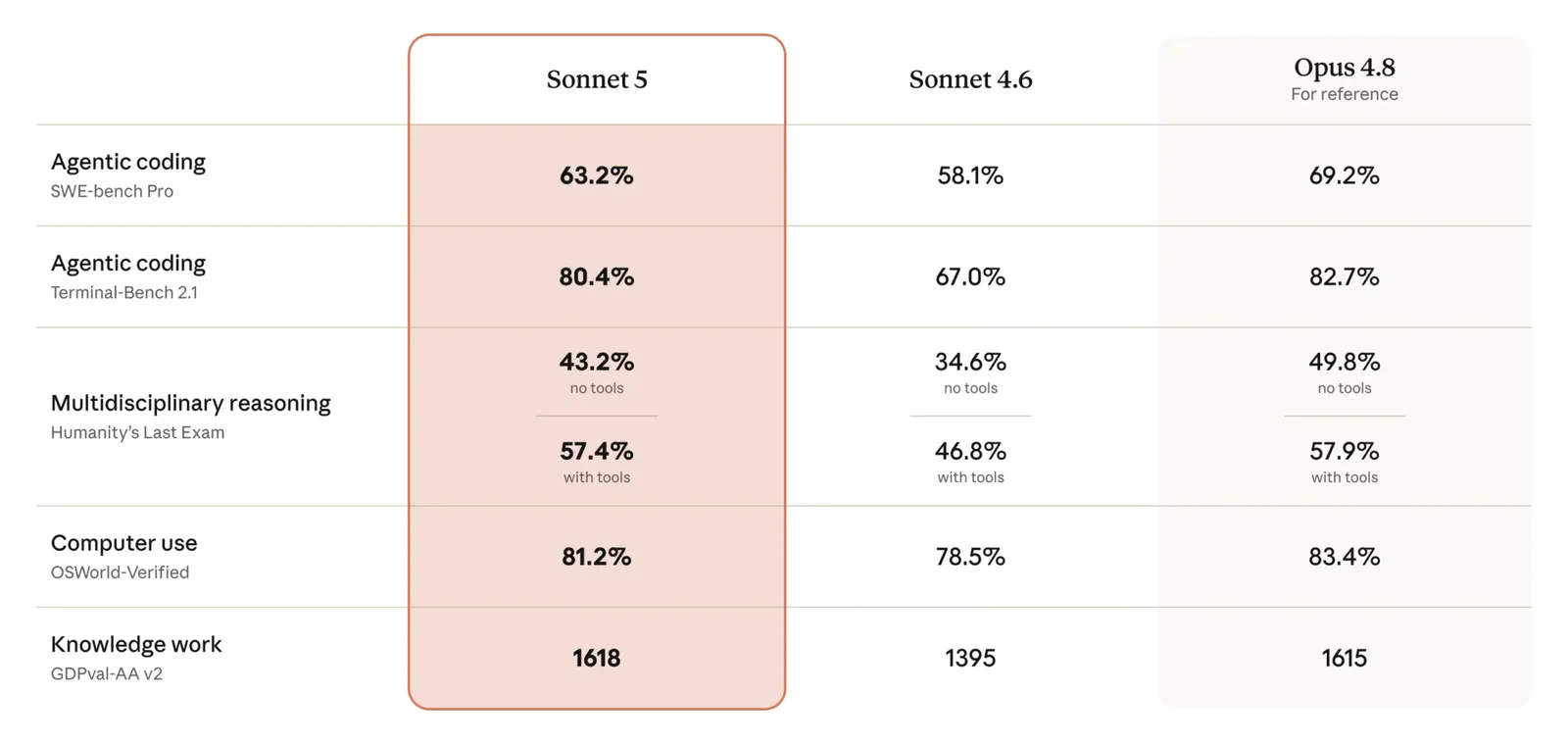
Sonnet 5 has a full public benchmark suite. GPT-5.6 has one confirmed coding number and several gaps where scores have not been published. The table below reflects that reality honestly.
| Benchmark | Sonnet 5 | GPT-5.6 Sol | Notes |
|---|---|---|---|
| SWE-Bench Verified | 85.2% | Not yet published | GPT-5.5 baseline: 88.4% |
| SWE-Bench Pro | 63.2% | Not yet published | GPT-5.5 baseline: 58.6% |
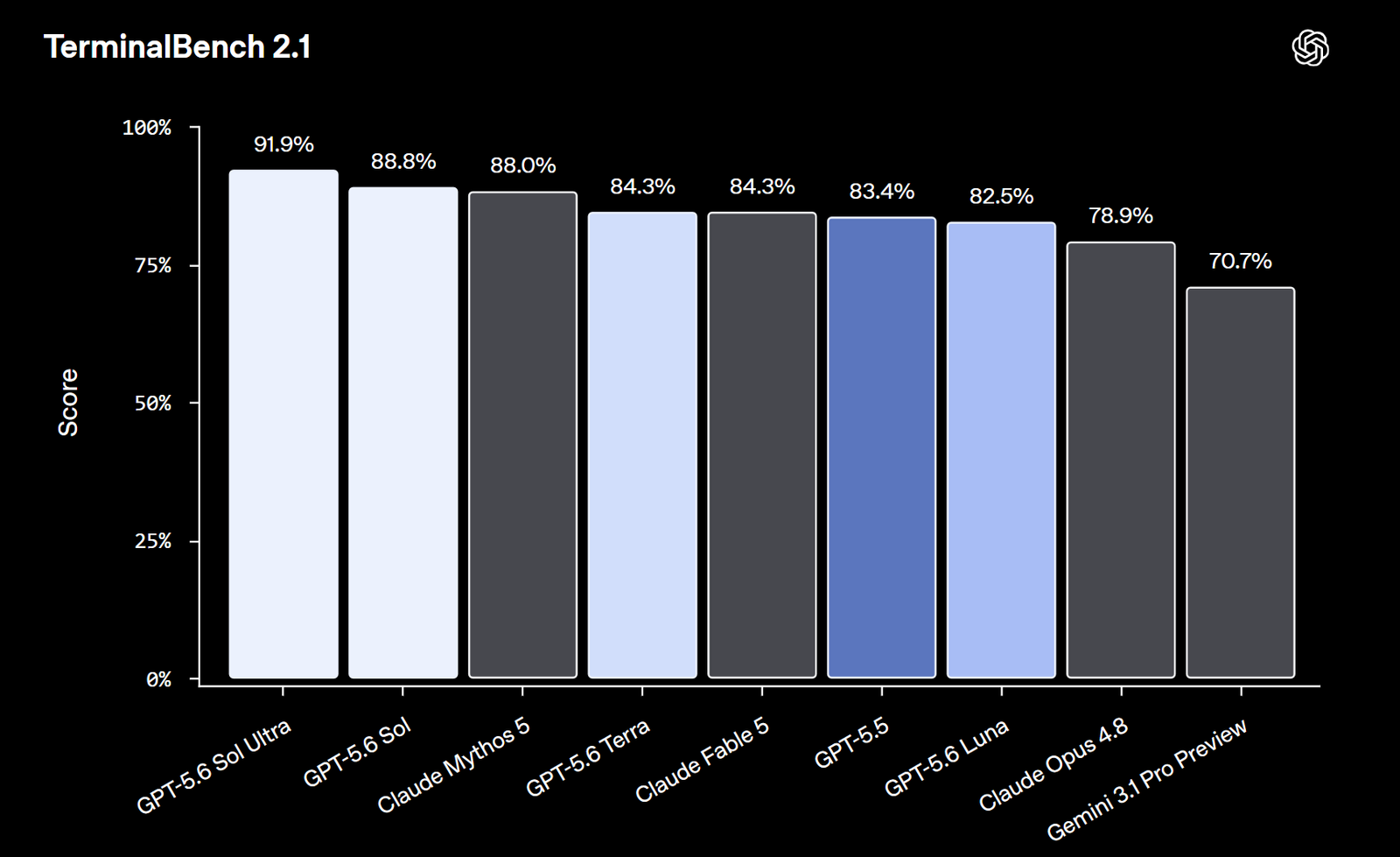
| Terminal-Bench 2.1 | 80.4% | 88.8% | Sol leads by 8.4 points |
| HLE with tools | 57.4% | Not yet published | |
| OSWorld-Verified | 81.2% | Not yet published | Computer use benchmark |
| CursorBench | 61.2% | Not yet published | |
| GDPval-AA Elo | 1618 | Not yet published | |
| Artificial Analysis Index | 53.35 (#5 / 161 models) | Not listed yet |
Terminal-Bench 2.1 is the only benchmark where a direct comparison currently exists. Sol scores 88.8% against Sonnet 5’s 80.4%. That 8.4-point gap is significant. Terminal-Bench measures performance on command-line, shell, and agentic coding tasks, which is exactly the kind of work developers run in CI pipelines and automated agents. Sol also beats Claude Fable 5 on the same benchmark, which scores 84.3%.
On SWE-Bench Pro, Sonnet 5 posts 63.2%. The GPT-5.5 baseline sits at 58.6%, so Sonnet 5 already leads GPT-5.5 on that metric. If Sol follows the progression pattern of the GPT-5 family, it should push above 63.2%. But no confirmed figure exists yet, and progression patterns are not guarantees.
The Availability Gap: Why It Actually Matters Right Now
Comparing a live model to a gated one is inherently awkward. This piece does not pretend otherwise. The availability gap is not a minor footnote. It is the central fact of this comparison as of July 2, 2026.
Sonnet 5 is live on Claude.ai, Claude Code, AWS Bedrock, Google Cloud, Microsoft Azure AI Foundry, and GitHub Copilot across all subscription tiers. Every major IDE with AI integration supports it. A developer can open their editor, point it at Sonnet 5, and start shipping code today. There is no waitlist and no approval process.
GPT-5.6 is live in the same technical sense, but only for roughly 20 organisations that went through a government-approval process. That is not a general release. It is a controlled preview. Third-party benchmarks are limited because almost no independent labs can run evals against the model. The 88.8% Terminal-Bench figure comes from OpenAI’s own published data. Independent verification has not happened yet at scale.
This asymmetry affects how you should read every comparison this week. Sonnet 5’s numbers have been stress-tested by external researchers. GPT-5.6’s numbers have not. That does not mean Sol’s published scores are wrong. It means you are comparing a well-audited model against a vendor self-report from a model in controlled preview.
The gap is expected to close around July 10-17 for ChatGPT subscribers and mid-to-late July for API users. If you are making infrastructure or tooling decisions that will hold for several months, waiting two to three weeks for independent GPT-5.6 evals is a reasonable call. If you need to ship something next week, Sonnet 5 is your answer.
Where Claude Sonnet 5 Wins
- Available right now. No waitlist, no government approval, no preview access. Sonnet 5 is live across every major cloud and IDE today.
- Full IDE and GitHub Copilot coverage. Sonnet 5 ships on GitHub Copilot across all subscription tiers, including the free tier. That is a meaningful distribution advantage for teams already inside the GitHub ecosystem.
- Introductory pricing through August 31. At $2/$10 per 1M tokens, Sonnet 5 is the cheapest capable mid-tier option currently available. That window closes September 1 when pricing moves to $3/$15. Teams that want to lock in production workloads at intro rates have roughly eight weeks.
- Strong agentic and CLI performance. Sonnet 5’s 80.4% Terminal-Bench score beats Claude Opus 4.8. That is the most capable coding model in Anthropic’s lineup on a benchmark explicitly measuring command-line and agentic task performance.
- 1M context window with adaptive thinking. Adaptive thinking is on by default at high effort. For large codebase analysis, long documentation ingestion, or multi-file refactoring, the 1M context window provides genuine headroom.
- Audited benchmark suite. External researchers have validated Sonnet 5’s numbers across SWE-Bench, OSWorld, HLE, and CursorBench. You are not relying solely on vendor claims.
Where GPT-5.6 Is Expected to Lead
- Terminal-Bench 2.1 lead is real. The 88.8% Sol score versus 80.4% for Sonnet 5 is the one confirmed head-to-head data point. An 8.4-point gap on CLI and agentic tasks is not marginal. If this holds under independent review, Sol leads on the coding tasks that matter most for automated pipelines.
- Terra’s pricing matches Sonnet 5’s standard tier. Terra at $2.50/$15 sits directly beside Sonnet 5’s standard $3/$15 pricing. If Terra delivers GPT-5.5-class performance or better at that price, it becomes a serious alternative once it opens broadly.
- 750 tokens per second on Cerebras. Sol’s Cerebras integration is a significant infrastructure play for latency-sensitive applications. Sonnet 5 runs at 84.8 tokens per second. Sol at 750 tokens per second is roughly 8x faster. For real-time code generation or interactive agents, that speed gap has practical consequences.
- Historical GPT-5 family trajectory suggests SWE-Bench gains. GPT-5.5 baseline on SWE-Bench Pro is 58.6%. Sonnet 5 sits at 63.2%. If Sol follows the progression seen in previous GPT-5 family iterations, it should exceed that. This is an expectation based on pattern, not a confirmed number.
- Three-tier flexibility. The Sol/Terra/Luna structure gives teams a clear upgrade path. You can run Luna for high-volume cheap tasks, Terra for standard coding work, and Sol for the hardest agentic tasks, all within the same API and billing relationship.
The Tokenizer Warning
Sonnet 5 ships with a new tokenizer that produces 27 to 42% more tokens for the same text compared to previous Anthropic models. English text gets tokenized at roughly 42% more tokens. Python code comes in at about 27% more tokens. That inflation has a direct cost impact.
At standard pricing, real-world cost per task works out to approximately $2.29, which is higher than Claude Opus 4.8’s $1.80. Do not budget for Sonnet 5 using the headline per-token rate without factoring in the tokenizer change. If you are running cost estimates for production workloads, test actual token counts on your specific codebase rather than assuming parity with Opus 4.8 or previous Sonnet models.
Which Should You Use?
The decision framework below cuts through the uncertainty.
- Use Sonnet 5 now if: you need a production-ready coding model immediately, your team works inside GitHub Copilot or any major IDE, you want to take advantage of introductory $2/$10 pricing before September 1, or your workloads benefit from the 1M context window with adaptive thinking.
- Wait for GPT-5.6 Terra if: your primary use case is CLI-heavy or agentic coding pipelines where the Terminal-Bench gap matters, you are making a long-term API commitment and can afford to wait until late July, or you want the three-tier flexibility of the Sol/Terra/Luna family before locking in infrastructure.
- Consider Sol if: you are running latency-sensitive production workloads where 750 tokens per second on Cerebras changes your architecture, you were already evaluating Claude Opus 4.8 at the $5 input price point and want to see how Sol compares, or you need the absolute ceiling on CLI and agentic task performance and cost is secondary.
- Hold off on major architectural commitments to GPT-5.6 until: independent benchmark data is published, the context window specifications are confirmed for all three tiers, and Terra’s performance numbers are available. Two to three weeks of patience will produce a much cleaner decision.
The Bottom Line
The Claude Sonnet 5 vs GPT-5.6 comparison is real, but it is also incomplete by definition. Sonnet 5 is a fully available, externally validated model with strong results across eight published benchmarks. GPT-5.6 Sol leads the one head-to-head coding benchmark that exists, but the model is not in your hands yet. For coding work today, Sonnet 5 is the right choice. It covers every IDE, sits on GitHub Copilot, and carries an introductory price that expires August 31. When GPT-5.6 opens to the public in mid-July, watch Terra most closely. At $2.50/$15 with expected GPT-5.5-plus performance, it will be Sonnet 5’s most direct rival. Run your own evals at that point, because the benchmark picture will look very different once independent data arrives.