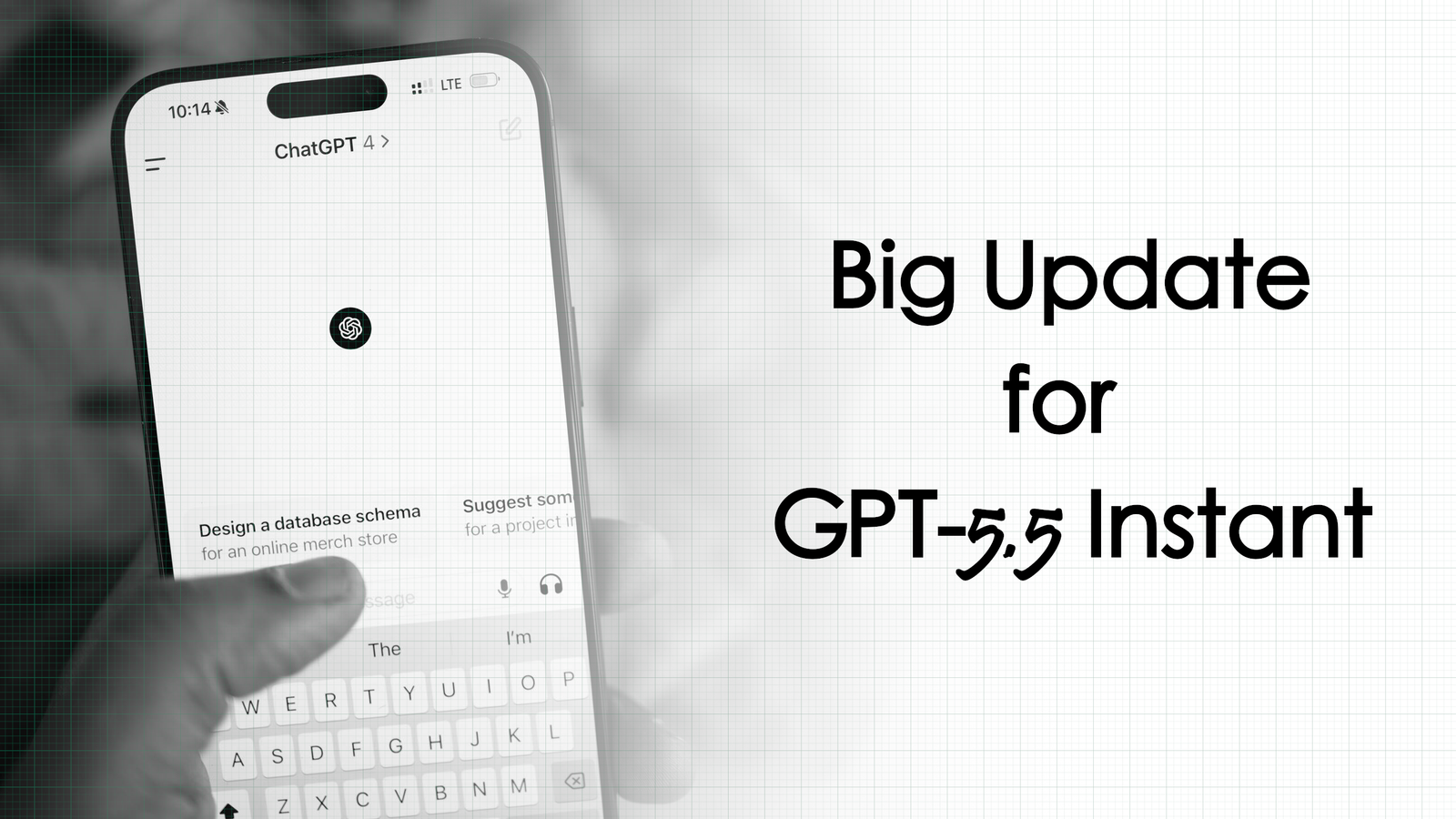
GPT-5.5 Instant launched on May 5 with a 52.5% reduction in hallucinated claims on high-stakes prompts and an AIME math score that jumped from 65.4 to 81.2. Those numbers were impressive enough to earn serious attention. Since then, OpenAI has quietly shipped two more updates, and on June 24 it shipped a third, this time focused on something harder to measure but arguably more important to the hundreds of millions of people who open ChatGPT every single day.
What Actually Changed on June 24
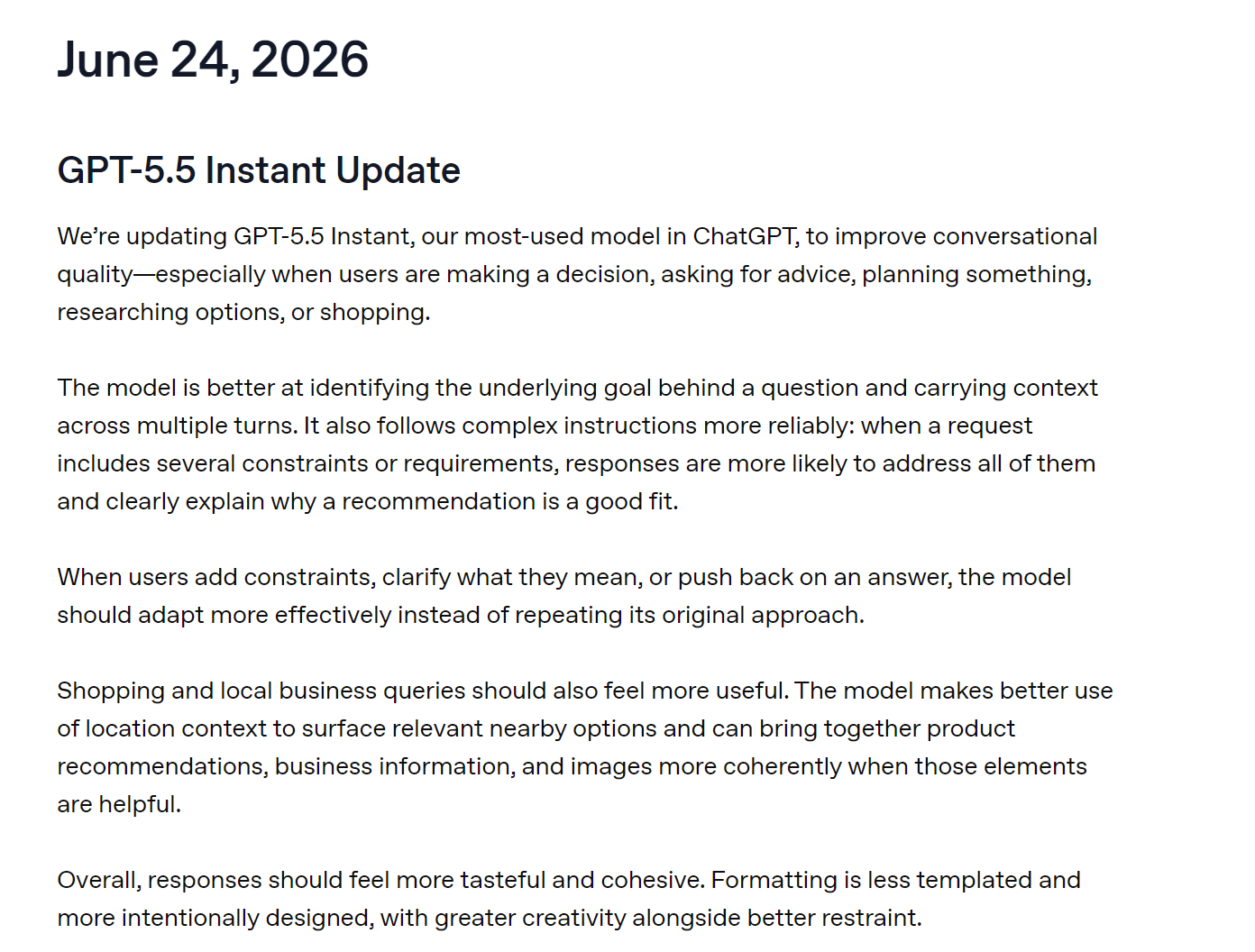
OpenAI described the June 24 update as making GPT-5.5 Instant “much more fun to talk to.” That phrase is intentionally casual, and it points directly at the four improvement areas the company identified.
- Advice-seeking conversations: The model now handles situations where you are not sure what you want to ask. If you describe a situation instead of asking a clean question, it should navigate toward a useful response rather than treating your input as a poorly formed query.
- Decision-making and planning: When you are weighing options, GPT-5.5 Instant is designed to work with your constraints rather than against them. Think itinerary planning, budget decisions, or project prioritization where the answer depends heavily on context you provide mid-conversation.
- Shopping interactions: Product comparisons, recommendation conversations, and purchase decisions are now a stated focus. The model should understand when you are in a buying mindset and adjust accordingly, rather than treating a shopping question the same as an informational one.
- Intent recognition and response adaptation: This is the underlying thread connecting the other three. The model should stop answering the question you asked and start answering the question you meant to ask. If you write “I need to fix my resume,” the intended response is different than if you write “what makes a good resume?” even though both touch the same topic.
These changes affect the default ChatGPT experience for every user, not a subset on a specific plan. If you opened ChatGPT on June 24, you were already using the updated model.
Why OpenAI Skipped the Benchmarks This Time
Every previous GPT-5.5 Instant update came with numbers. The May 5 launch cited specific hallucination reduction percentages and benchmark scores. The June 18 health intelligence update pointed to HealthBench evaluations comparable to frontier Thinking models. The June 24 update published none of that, and the absence is worth taking seriously.
Conversational quality does not fit cleanly into a benchmark. There is no standard test for whether a model correctly identifies that someone asking about “good shoes for walking a lot in Europe” is actually planning a trip, not researching podiatry. Intent recognition is qualitative. It lives in the gap between what people type and what they mean, and that gap resists scoring.
OpenAI’s decision to skip the numbers is a signal about what they believe matters most to mass users right now. The model already scores well on math and factual accuracy. The next frontier is whether it feels like talking to something that actually gets you. That is harder to prove with a spreadsheet, but it is what drives retention at scale, and OpenAI clearly knows it.
The shopping focus makes this even more explicit. Amazon’s Rufus and Google Shopping’s AI layer are both competing for the same use case, and that competition is worth billions in commerce revenue. OpenAI does not need a benchmark to justify investment in that area. It needs the model to actually help people buy things, and the only real test of that is whether users keep using it for shopping.
GPT-5.5 Instant’s Update Track Record
Three meaningful updates in 50 days is a fast cadence for a frontier model. This is iterative deployment, not the old cycle of training for a year and shipping once. Here is the full timeline.
| Update | Date | Focus | Key Numbers |
|---|---|---|---|
| Launch | May 5, 2026 | Accuracy and reasoning | 52.5% fewer hallucinated claims vs GPT-5.3 Instant; AIME score from 65.4 to 81.2 |
| Update 1 | June 9, 2026 | Personalization (Plus/Pro) | Better context retrieval from chats, files, and connected Gmail accounts |
| Update 2 | June 18, 2026 | Health intelligence | Comparable to frontier Thinking models on HealthBench evaluations |
| Update 3 | June 24, 2026 | Conversational quality and intent recognition | No quantitative benchmarks published |
Each update has addressed a different dimension of the model’s usefulness. The launch focused on trustworthiness. The first update made it more personal. The second made it more reliable in health contexts. The third is trying to make it more human to interact with. Taken together, they sketch a clear product philosophy: ship a capable model, then refine the experience rapidly based on where users are actually spending time.
What This Means for How You Use ChatGPT
The practical impact of the June 24 update depends on how you currently use ChatGPT. Some use cases will feel the difference more than others.
- If you use ChatGPT for advice: Describe your situation instead of asking a clean question. The updated model is specifically tuned for that kind of input, and it should produce recommendations that reflect your actual context rather than generic guidance.
- If you use it for planning: Give it your constraints upfront. Budget, timeline, preferences, non-negotiables. The intent recognition improvements are designed to hold those constraints throughout the conversation rather than treating each message in isolation.
- If you use it for shopping: Try asking the way you would ask a knowledgeable friend, not the way you would type into a search bar. “I need a laptop for video editing under $1,500 and I travel a lot” should now produce a more targeted response than it did before June 24.
- If you are a writer or content professional: The advice-seeking and intent recognition improvements matter for creative briefs, research conversations, and revision feedback. The model should be better at understanding what kind of help you are actually looking for when your request is open-ended.
- If your use case is technical or analytical: This update is not primarily aimed at you. The launch benchmarks and health intelligence update are more relevant to that work. The June 24 changes will still affect your experience, but the improvements are most visible in conversational, goal-oriented interactions.
The Bottom Line
OpenAI made GPT-5.5 better at talking to you by focusing on what happens between the lines of your messages, specifically the intent behind them, rather than the words themselves. This is not a minor quality-of-life patch. It reflects a bet that conversational intelligence, the kind that makes you feel understood rather than processed, is what actually determines whether hundreds of millions of people keep using ChatGPT as their default tool. Skipping benchmarks for this update was not an oversight. It was an honest acknowledgment that the thing they are trying to improve cannot be scored on a leaderboard. Whether it lands will show up in usage patterns, not evaluation sets. For everyday users, the best way to test it is to start a conversation with some context and see whether the response surprises you with how well it fits what you actually needed.