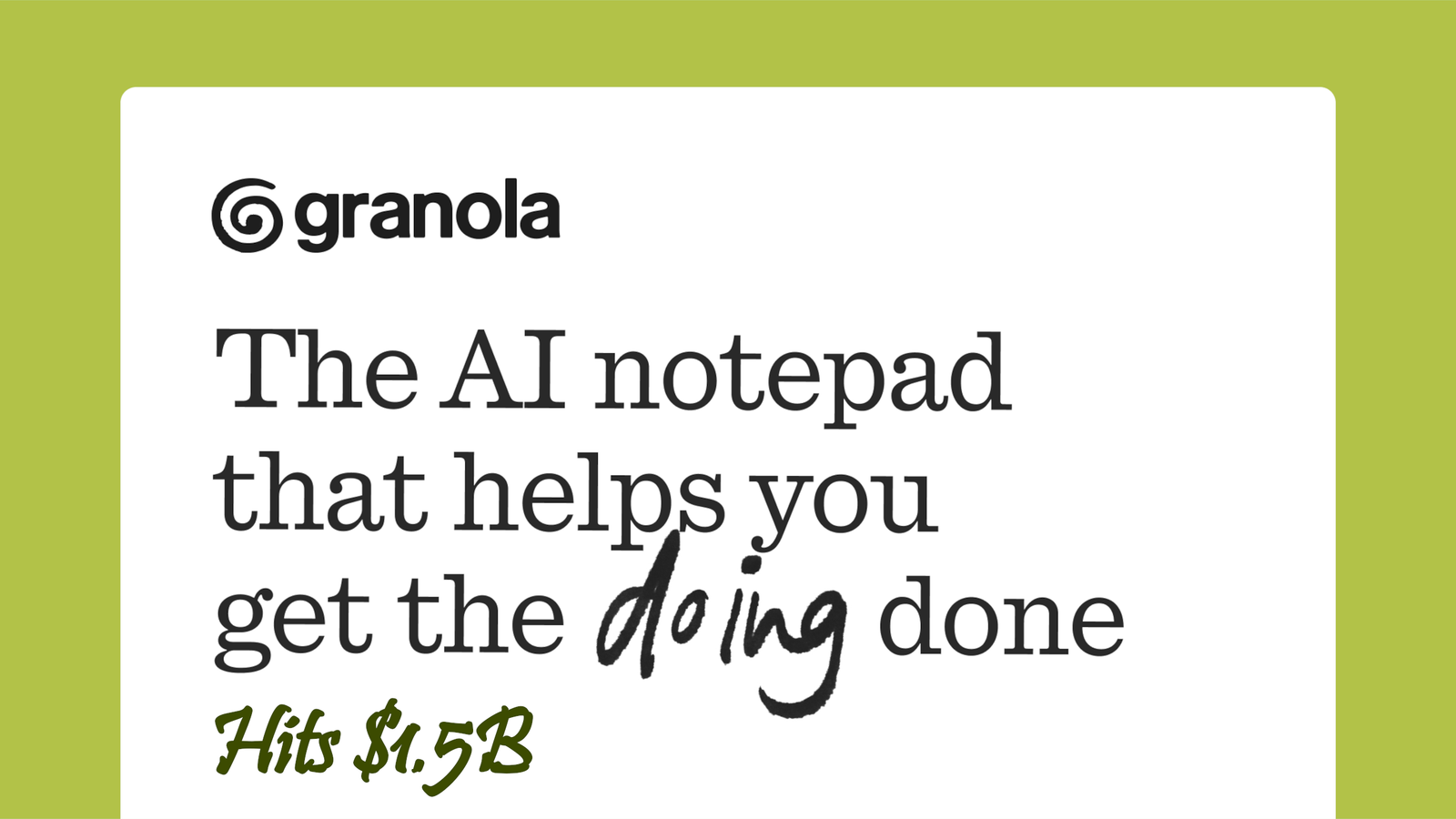
On March 25, 2026, Granola closed a $125 million Series C at a $1.5 billion valuation. Ten months earlier, the company was worth $250 million. That six-fold jump in under a year is not just a funding story — it is a signal that AI meeting notes has quietly become one of the most commercially validated categories in the productivity stack. Here is what is driving it, who the real players are, and whether Granola actually deserves the valuation.
The Numbers Behind Granola’s Raise

The Series C was led by Danny Rimer of Index Ventures and Mamoon Hamid of Kleiner Perkins, with Lightspeed Venture Partners, Spark Capital, and NFDG returning from previous rounds. Total raised across all rounds now sits at $192 million.
| Round | Date | Amount | Valuation |
|---|---|---|---|
| Seed | May 2023 | $4.25M | Undisclosed |
| Series A | October 2024 | $20M | Undisclosed |
| Series B | May 2025 | $43M | $250M |
| Series C | March 2026 | $125M | $1.5B |
The team grew from 19 people in May 2025 to 116 by May 2026. That is a 6x headcount increase in 12 months, which tells you the company is in aggressive scaling mode, not just holding its position.
Enterprise clients named in the Series C announcement include Vanta, Gusto, Thumbtack, Asana, Cursor, Lovable, Decagon, and Mistral AI. The list skews heavily toward high-growth tech companies, which is exactly the demographic most likely to spread a product through word of mouth.
What Makes Granola Different From Every Other Meeting Tool
Most AI meeting tools work by joining the call as a bot. You have seen the notification: “Otter has joined the meeting.” Granola does not do this.
Instead, the desktop app captures system audio directly from your operating system — both speakers and microphone — and processes it locally during the meeting. Audio is discarded when the session ends. No recording is stored. No bot announcement disrupts the dynamic.
Zachary Proser, who tested Otter, Fireflies, Fathom, Avoma, Grain, and Read AI before switching, put it plainly: “People started being more candid. I heard things I wasn’t hearing before.” That effect — participants behaving differently when they know a bot is in the room — is real, and it is the single most cited reason Granola users switch from bot-based tools.
The workflow is also distinct. During the meeting, you jot rough bullet points in Granola. After the call ends, the AI synthesises your notes with the transcript. Your bullets appear in black; AI-generated additions appear in grey. The result is a structured summary that amplifies what you actually wrote, rather than replacing it with generic output.
Granola’s technical approach: Local system audio capture, real-time transcription, audio discarded post-session, 90-95% transcription accuracy. No video, no screen recording, no stored audio files. Available on macOS, Windows, and iOS. No web app, no Android yet.
The March 2026 Product Launches That Changed the Story
The Series C was not just a funding announcement. Three product launches came with it, and they shift Granola from a personal productivity tool to an enterprise data layer.
Spaces: Team workspaces with hierarchical folders, granular access controls, and integrated Granola Chat. Teams can now build a shared repository of meeting context, query it conversationally using Claude, GPT, or Gemini, and filter notes by company, person, or project. This is the feature that makes Granola a team product rather than a solo tool.
Personal API: Available on Business and Enterprise plans. Lets individuals pipe their meeting context programmatically into other AI tools. The integration partners include Claude, ChatGPT, Lovable, Figma Make, Replit, Manus, v0, and Bolt.new. Your meetings become a data source that your other AI workflows can query.
Enterprise API: Available on Enterprise plans. Lets admins access and manage organisation-wide meeting context. The use case is integrating meeting intelligence into enterprise knowledge bases, internal AI systems, and CRM workflows at scale.
The MCP server launched one month earlier, in February 2026, and implements Anthropic’s Model Context Protocol. It lets AI tools pull Granola meeting context in the background without any user action. CEO Chris Pedregal described the direction plainly: “We want to make it easy to put your company’s context to work for you — both inside of Granola and in the other tools you use.”
How Big Is This Market Actually?
The numbers explain why investors are writing large checks.
- 55 million meetings happen in the US every week (Cirrus Insight)
- 75% of professionals now use an AI note-taker in work meetings — roughly double the 2023 figure (Laxis State of Meeting Note-Taking 2026)
- 67% of Fortune 500 companies have deployed AI note-takers somewhere in their organisation
- The AI note-taking market was worth $740 million in 2026, growing to a projected $3.48 billion by 2035 at an 18.75% CAGR (Precedence Research)
- 46% of professionals attend three or more meetings per day; the average employee spends 11 to 12 hours per week in meetings
Meeting capture has become the primary entry point for enterprise AI deployment. It is low risk, has a measurable productivity payoff, and generates structured context that feeds every other AI system downstream. When IBM’s Global AI Adoption Index found that 45% of companies now use AI for internal knowledge management, meeting capture is the single largest source of that context.
The Competitor Landscape: Where Granola Sits
| Tool | Bot-free? | Free tier | Paid from | Standout feature |
|---|---|---|---|---|
| Granola | Yes | 25 notes (lifetime cap) | $14/user/mo (Business) | Hybrid notes, Spaces, APIs, MCP server |
| Fathom | No | Unlimited (generous) | $19/user/mo (Team) | Most generous free tier in the category |
| Fireflies.ai | No | Limited minutes | $10/user/mo | 100+ languages, sales/CRM focus |
| Otter.ai | No | 300 min/mo | $8.33/user/mo | Real-time live transcription |
| tl;dv | No | Unlimited recordings | $18/user/mo | Video clipping and timestamped sharing |
| Read AI | No | 5 meetings/mo | $16.99/mo | Engagement and sentiment scoring |
| Jamie | Yes | Limited | $19/mo | Bot-free alternative to Granola |
| Notion AI | Yes | No (requires Business plan) | $20/user/mo (Business) | Native Notion workspace integration |
Fathom is the most direct competitive threat. Its free tier is genuinely unlimited — unlimited recordings, transcription, and AI summaries — and it has no monthly cap. For individuals who are price-sensitive, Fathom is the harder argument to beat. Granola’s counter is product depth: the Spaces collaboration layer, the APIs, and the MCP integration exist nowhere in Fathom’s roadmap.
Jamie is the less-covered competitor worth watching. Like Granola, it uses local audio capture with no bot. It is priced lower at $19/month for Pro and is gaining traction among privacy-conscious users who want bot-free notes without Granola’s pricing structure.
What Granola Does Not Do Well
Honest assessment. Granola has real limitations that the funding headlines tend to skip.
- No speaker identification — in meetings with three or more participants, attributing who said what requires manual review. This is a genuine gap for legal, compliance, or complex project teams.
- No audio playback — audio is discarded after processing. If the transcript gets something wrong, there is no recording to verify against. Fireflies and Otter both retain audio.
- 25-note lifetime cap on the free plan — not 25 per month. 25 total. Once you hit it, you subscribe or stop using the product. Fathom’s unlimited free tier is a meaningful difference here.
- AI training opt-out gated to Enterprise ($35/user/month) — lower-tier users are opted into AI model training by default. For privacy-sensitive teams, this is a blocker that requires paying for the highest tier to resolve.
- No web app, no Android — access requires the desktop or iOS app. Android is on the roadmap with no confirmed date.
Why the $1.5B Valuation Makes Sense (and Where the Risk Is)
Granola is not being valued as a meeting transcription tool. It is being valued as an enterprise context layer — a system that turns unstructured conversation into structured, queryable, AI-ready data that feeds every other tool in a company’s stack.
The Spaces launch, the Personal API, the Enterprise API, and the MCP server all point in the same direction: Granola wants to be the place your company’s conversational knowledge lives, and the pipe through which that knowledge flows into AI agents, CRMs, knowledge bases, and productivity tools.
Wade Foster, founder of Zapier, cited Granola as his personal favourite AI tool. That is the kind of organic endorsement from a credible operator that signals genuine product-market fit, not just hype.
The risk is execution. Scaling from 19 to 116 employees in 12 months while simultaneously launching enterprise features, APIs, and a collaboration layer is a lot to manage. The history of productivity SaaS is full of well-funded tools that sprawled beyond their core use case and lost the product clarity that made them great.
What is Granola and how does it work?
Granola is an AI meeting notes app that captures your meetings without joining as a bot. It records system audio locally on your device, generates a real-time transcript, and discards the audio after the session ends. Post-meeting, you jot rough notes during the call and the AI synthesises them with the transcript into structured summaries with action items and key decisions.
Is Granola better than Otter.ai?
For most use cases, yes. Granola’s bot-free approach changes meeting dynamics, its hybrid note model produces better summaries than pure auto-transcription, and its API and MCP integrations make it more useful as part of a broader AI workflow. Otter’s edge is real-time live transcription — text appears as people speak — and a lower price point starting at $8.33/month.
How much does Granola cost?
Granola has a free plan capped at 25 lifetime notes. Individual paid plans start around $18/month. The Business plan is $14/user/month with team features and Personal API access. Enterprise is $35/user/month with SSO, SCIM, Enterprise API, and AI training opt-out controls.
Who founded Granola?
Granola was founded by Chris Pedregal and Sam Stephenson in 2023 in London. Pedregal is a former Google product manager who previously founded Socratic, an AI tutoring app that Google acquired in 2018. Stephenson created Prototype.js, which was adopted by tens of millions of websites globally.
Wrapping Up
Granola’s $1.5 billion valuation reflects a bet that meeting capture becomes the primary entry point for enterprise AI — not a standalone notes tool, but the conversational context layer that every other AI system in a company draws from. The product moves, the API launches, and the MCP integration all support that thesis.
- Try the free tier before it runs out. The 25-note lifetime cap is restrictive, but it is enough to evaluate whether the bot-free workflow and hybrid note model actually change how your meetings feel.
- If you are on a team, look at Spaces. The collaborative context layer that Granola launched in March 2026 is the feature that separates it from every individual-focused competitor in the category.
- Connect Granola to your AI tools via MCP. If you use Claude, ChatGPT, or any of the Antigravity/Lovable/Replit tools, the MCP server integration lets those tools pull your meeting context automatically. That connection is where Granola’s value multiplies.