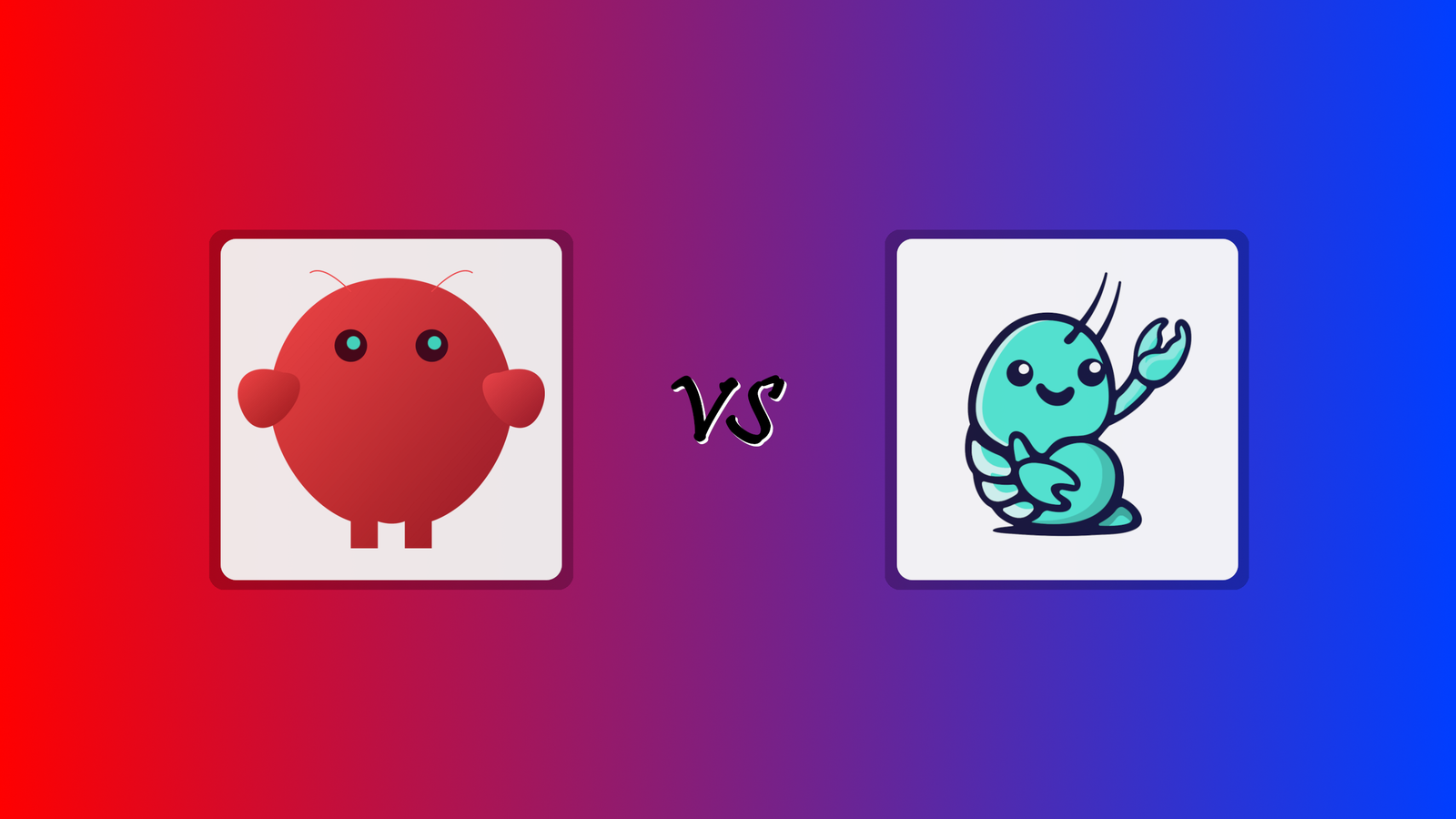
Two distinct philosophies define the AI agent landscape in 2026, and they could not be more different. OpenClaw is ecosystem-first: 350,000 GitHub stars, 40,000 community skills, and a foundation backed by OpenAI. NanoClaw is security-first: 600 lines of TypeScript, zero CVEs, and an architecture small enough to audit in eight minutes. If you need a direct answer before we dig in, here it is.
OpenClaw wins on raw capability and integrations. NanoClaw wins on security and operational simplicity. But the right choice for YOU depends on your team’s risk tolerance, infrastructure budget, and how much of your stack you can afford to expose. This article gives you every number, every CVE, and every architectural detail you need to make that call confidently in mid-2026, well after the security crisis that reshaped this market.
What Are OpenClaw and NanoClaw?
OpenClaw is an open-source AI agent framework that started life as “Clawdbot” in November 2025. It has since grown into one of the fastest-growing open-source projects ever recorded, with a community marketplace, multi-LLM support across eight providers, and a binary that ships roughly 500,000 lines of code. NanoClaw is a deliberate counterpoint: a TypeScript-native agent runtime built by NanoCo AI, launched on January 31, 2026, with OS-level sandboxing baked in from day one. Here is how the two frameworks compare at a glance.
| Dimension | OpenClaw | NanoClaw |
|---|---|---|
| Codebase size | ~500,000 lines of code | ~600 lines of TypeScript |
| GitHub stars | 350,000+ (April 2026) | ~29,000 |
| Downloads | Not publicly disclosed | 250,000+ |
| RAM at idle | >1 GB | ~50 MB |
| Startup time | >500 ms; cold boot 8-12 s | Near-instant |
| LLM support | Anthropic, OpenAI, Ollama, Qwen, Fireworks AI, StepFun, MiniMax, Amazon Bedrock | Runs on Anthropic Agent SDK; multi-LLM via MCP |
| CVEs (June 2026) | 138+ CVEs, 60+ GHSAs | Zero |
| License | MIT | Not disclosed publicly |
| Pricing (teams) | $300-750/month (infra + API) | $5-50/month self-hosted |
How Did We Get Here? The Origin Stories

OpenClaw: From Clawdbot to Foundation
Austrian developer Peter Steinberger shipped the first commit of Clawdbot in November 2025. The project caught fire almost immediately, accumulating stars at a pace that drew comparisons to early Node.js adoption. On February 15, 2026, Sam Altman announced on CNBC that Steinberger had joined OpenAI. The move could have killed community trust in the project, but Steinberger and Altman moved quickly: OpenClaw was transferred to an independent OpenClaw Foundation. OpenAI funds the foundation and contributes engineering resources, but it does not hold a controlling seat. The MIT license remains intact. That governance structure has been central to the project’s legitimacy with enterprise adopters who watched the drama closely.
NanoClaw: Built Because of the Crisis
Brothers Gavriel Cohen and Lazer Cohen founded NanoCo AI and launched NanoClaw on January 31, 2026. The timing was not accidental. They watched OpenClaw’s security incidents accumulate through late 2025 and early 2026, and they built NanoClaw as a direct architectural response. The framework attracted immediate attention from Andrej Karpathy, who described the code as “really interesting” and noted that it “fits into both my head and that of AI agents, so it feels manageable, auditable, flexible.” That endorsement drove the first wave of serious enterprise inquiries. The Cohens rejected a $20 million acquisition offer, choosing to stay independent. On May 20, 2026, NanoCo closed a $12 million seed round led by Valley Capital Partners, with participation from Docker, Vercel, monday.com, Slow Ventures, Clutch Capital, Factorial Capital, and Clem Delangue, the CEO of Hugging Face.
Architecture: 500,000 Lines vs 600 Lines
The line-count gap is not just a trivia point. It represents two fundamentally different theories about what an AI agent runtime should be.
OpenClaw’s Layered Approach
OpenClaw is built as an application-layer platform. Security is handled at the software level: authentication middleware, permission scopes, and token validation all run inside the same process as the agent logic. The framework ships with 70 or more software dependencies and a binary weighing roughly 28 MB. At idle, the process consumes more than 1 GB of RAM. Cold boot time on a standard VPS runs between 8 and 12 seconds. These numbers are not dealbreakers for large teams with dedicated infrastructure, but they become significant at scale. Tencent Cloud benchmarks on a 2-core, 4 GB configuration show OpenClaw handling a maximum of 12 requests per second with up to 40 concurrent users at under 5 seconds P95 latency. Push past 16 concurrent users and throughput degrades by 50 percent.
The v2026.4.5 release, shipped in April, added the “/dreaming” memory system, which processes agent memory in three phases: Light Sleep, REM Sleep, and Deep Sleep. The same release bundled built-in video generation through xAI Grok, Runway, Google, and MiniMax, music generation through Google Lyria and MiniMax, and support for 12 new UI languages. The v2026.5.22 release in May focused on gateway performance improvements. Both updates illustrate OpenClaw’s philosophy: add capabilities rapidly, let the community surface problems, patch aggressively.
NanoClaw’s OS-Level Security Model
NanoClaw inverts the security model entirely. Instead of securing the application layer, it secures at the OS level. Every agent session runs inside a Docker MicroVM container that self-destructs when the session ends. The container has no persistent access to the host filesystem, no ability to exfiltrate credentials, and no surface for the kinds of privilege escalation attacks that have plagued OpenClaw.
The OneCLI Rust Gateway is the other critical architectural piece. Raw API credentials never reach the agent process. The gateway injects credentials at runtime, so even if an agent is compromised, the attacker cannot harvest keys. NanoClaw partnered formally with Docker Sandboxes in March 2026, integrating the MicroVM isolation model as a first-class deployment primitive. The entire runtime, at roughly 600 lines of TypeScript, consumes around 50 MB of RAM at idle. That is roughly a 20-to-1 memory advantage over OpenClaw. A security team can audit the complete codebase in approximately eight minutes, compared to days or weeks for OpenClaw’s 500,000-line codebase.
Key architectural comparison: OpenClaw secures at the application layer with middleware and token scopes. NanoClaw secures at the OS layer with ephemeral MicroVM containers and a Rust gateway that never exposes raw credentials to the agent. These are not equivalent approaches dressed up differently. They represent a genuine philosophical divide on where trust boundaries should live.
The Security Crisis That Changed Everything
No comparison of OpenClaw and NanoClaw in 2026 is honest without a full accounting of what happened to OpenClaw’s security posture in the first half of the year. The numbers are significant.
CVEs and Critical Vulnerabilities
As of mid-2026, OpenClaw has accumulated 138 or more CVEs and 60 or more GitHub Security Advisories. Two vulnerabilities stand out above the rest.
- CVE-2026-25253 (CVSS 8.8): A one-click remote code execution vulnerability. An attacker could trigger arbitrary code execution with a single crafted request. Patched in v2026.1.29.
- CVE-2026-32922 (CVSS 9.9): A privilege escalation flaw granting full system access. This is a near-perfect CVSS score, indicating critical severity with wide impact and no meaningful mitigating factors.
ARMO Security published findings in April 2026 showing 135,000 or more exposed OpenClaw instances spread across 82 countries. The more alarming statistic: 63 percent of those instances had zero authentication configured. Default installations were shipping into production without any access control, and nobody was locking the door.
The ClawHavoc Campaign
The supply chain threat inside the ClawHub skill marketplace turned out to be as serious as the CVEs in the core runtime. Koi Security audited 2,857 ClawHub skills and found 341 flagged as malicious. Of those, 335 came from a single coordinated operation. That is roughly 1 in 12 packages carrying a malicious payload. The primary attack vector on macOS was the Atomic macOS Stealer, a payload designed to harvest browser credentials, macOS keychain data, SSH keys, and cryptocurrency wallets. Teams that had installed even a small number of community skills without auditing them were potentially fully compromised.
This campaign is now called ClawHavoc in security circles. It illustrates the systemic risk that comes with a large, fast-growing open marketplace where package provenance is difficult to verify at scale.
NanoClaw’s Architectural Response
NanoClaw launched in direct response to exactly these failure modes. The MicroVM container model means that even a fully malicious skill cannot persist beyond a single session. The OneCLI Rust Gateway means that API credentials are never accessible to the agent process, eliminating the credential harvesting vector entirely. The 600-line codebase means that a security team can verify the entire runtime surface in a single morning. As of June 2026, NanoClaw holds zero CVEs.
Benchmarks: What PinchBench Actually Tells Us
PinchBench is the official benchmark for OpenClaw performance, built by kilo.ai in Rust. It covers 23 real-world task categories across 5 performance dimensions, with 49 models and 327 run records as of the most recent public data. The benchmark is the closest thing the OpenClaw ecosystem has to a standardized, reproducible performance comparison.
Here are the top 5 results from the March 13, 2026 run.
| Rank | Model | PinchBench Score |
|---|---|---|
| 1 | Claude Sonnet 4.6 | 86.9% |
| 2 | Claude Opus 4.6 | 86.3% |
| 3 | GPT-5.4 | 86.0% |
| 4 | Nvidia Nemotron-3-Super-120B | 85.6% |
| 5 | Claude Opus 4.5 | 85.4% |
The most important takeaway from this table is the gap: only 1.5 percentage points separate rank 1 from rank 5. In practical terms, this means model selection for OpenClaw should not be driven by benchmark chasing. The performance differences between top-tier models in real-world agent tasks are small enough that other factors, such as cost per token, latency, and data handling agreements, will matter more for most teams.
PinchBench’s five dimensions measure reasoning accuracy, tool use reliability, instruction following, multi-step coherence, and context retention. The 23 task categories include things like web research, code generation, form completion, and calendar management. These are genuine user-facing tasks, not synthetic puzzles, which makes the benchmark more useful than most LLM leaderboards for predicting agent behavior in production.
NanoClaw does not have its own equivalent benchmark suite yet, though the framework’s performance in practice tracks closely with the underlying model scores, since the runtime overhead is so small.
Ecosystem and Integrations
OpenClaw’s Breadth
OpenClaw’s ecosystem is genuinely impressive in scope. The ClawHub marketplace lists more than 40,000 community skills. The framework supports eight LLM providers natively: Anthropic, OpenAI, Ollama, Qwen, Fireworks AI, StepFun, MiniMax, and Amazon Bedrock. There are 70 or more software integrations available, covering everything from calendar apps to code editors. The v2026.4.5 release added video generation through four providers and music generation through two, plus a three-phase memory consolidation system that lets agents process and compress long-term memory during idle periods. These are capabilities that NanoClaw does not currently match on raw feature breadth.
The caveat to all of this is ClawHavoc. With roughly 1 in 12 ClawHub packages flagged as malicious in the Koi Security audit, any team using community skills needs to treat the marketplace as an untrusted source and audit packages independently before installation. That work is real, and it carries a cost.
NanoClaw’s Targeted Integration Strategy
NanoClaw takes a narrower, deeper integration approach. The Vercel unified SDK lets developers deploy an agent to 15 messaging channels from a single TypeScript codebase. That is a meaningful productivity gain for teams building customer-facing agents across Slack, WhatsApp, SMS, and other channels simultaneously. MCP Server support gives NanoClaw access to a growing ecosystem of tools without requiring the framework to ship integrations natively. Multi-agent swarms use isolated CLAUDE.md group memory files per swarm, which keeps context separation clean and auditable. Enterprise deployments add a persistent knowledge base described by the team as a “Wikipedia of you,” plus human-in-the-loop approval workflows via Slack and WhatsApp.
Real Costs: What You Actually Pay
The pricing difference between these two frameworks is substantial, but the full picture requires accounting for hidden infrastructure costs that do not show up in headline numbers.
| Cost Component | OpenClaw | NanoClaw |
|---|---|---|
| Self-hosted monthly | Not publicly listed | $5-50/month |
| Team pricing | $300-750/month (infra + API) | Enterprise via NanoCo |
| Hardware floor (RAM) | >1 GB required at idle | ~50 MB at idle |
| Security hardening | Significant: WAF, auth layer, marketplace auditing | Included in architecture |
| CVE patching overhead | 138+ CVEs tracked; ongoing patch cycle | Zero as of June 2026 |
| Skill marketplace auditing | Required; 1 in 12 packages flagged malicious | Not applicable |
The $300 to $750 monthly range for OpenClaw teams covers infrastructure and API costs but does not include the engineering time needed to harden a default installation. A team that deploys OpenClaw without additional authentication, without a web application firewall, and without auditing their ClawHub dependencies is running in a configuration that ARMO Security documented as the norm among the 135,000 exposed instances they found in April 2026. The true cost of a secure OpenClaw deployment is higher than the headline number.
NanoClaw’s $5 to $50 self-hosted range is genuinely low because the architecture ships security as a default. You are not paying less and getting less security. You are paying less because the security model is built into the runtime rather than bolted on afterward.
When to Choose OpenClaw
OpenClaw is the right choice in specific situations where its ecosystem depth justifies the operational complexity and security overhead.
- You need access to 40,000-plus community skills and your team has the bandwidth to audit packages before installation.
- Your use case requires video generation, music generation, or the /dreaming memory consolidation system, which are not available in NanoClaw today.
- You are building on a multi-LLM strategy across eight providers and need all of them natively supported in one framework.
- Your team has dedicated security and DevOps engineers who can own the hardening work: proper authentication, WAF configuration, and ongoing CVE patching.
- Community size matters to your team. OpenClaw’s 350,000 GitHub stars mean a much larger pool of tutorials, answers on Stack Overflow, and third-party tooling.
- You need the /dreaming memory system or other features from the v2026.4.5 release cycle that have no equivalent in the NanoClaw roadmap yet.
When to Choose NanoClaw
NanoClaw wins clearly in contexts where security posture, auditability, or lean infrastructure are primary concerns.
- Your deployment handles sensitive data: credentials, financial records, personal health information, or anything that lives in a browser keychain or SSH key store.
- Your security team needs to audit the runtime surface. Eight minutes to review the entire codebase is a realistic promise with 600 lines of TypeScript.
- You are deploying to resource-constrained environments where 50 MB RAM usage is a meaningful advantage over 1 GB-plus.
- You need to deploy agents to 15 messaging channels from a single codebase, using the Vercel unified SDK.
- Your compliance or regulatory environment requires demonstrable credential isolation. The OneCLI Rust Gateway provides a documented, testable guarantee that raw API keys never reach the agent process.
- You are a small team or solo developer who cannot afford to maintain a security hardening layer on top of a 500,000-line codebase.
What About NemoClaw?
NVIDIA launched NemoClaw at GTC 2026, targeting enterprise deployments at scale. The framework has signed clients including Adobe, Salesforce, SAP, Cisco, and Google. Its underlying model, Nvidia Nemotron-3-Super-120B, ranked fourth on PinchBench with a score of 85.6 percent, just 1.3 percentage points behind Claude Sonnet 4.6. For organizations already deep in the NVIDIA infrastructure stack, NemoClaw offers a compelling path: enterprise support contracts, hardware-optimized inference, and a client list that signals production-readiness. It is not a direct competitor to either OpenClaw or NanoClaw for most developers, but it is worth knowing it exists if your team is evaluating all options for large-scale enterprise deployments.
Migrating from OpenClaw to NanoClaw
If you are currently running OpenClaw and want to evaluate NanoClaw, a clean migration is achievable in most cases. Here is a practical guide.
Step 1: Run Both Frameworks in Parallel
Do not cut over immediately. Stand up NanoClaw in a separate environment and route a subset of non-critical agent tasks to it for two to four weeks. This lets you validate that task completion rates match your OpenClaw baseline before you commit to the migration.
Step 2: Reconfigure API Keys via OneCLI Gateway
NanoClaw’s OneCLI Rust Gateway handles credential injection at runtime. You will need to register your API keys with the gateway rather than passing them as environment variables to the agent process. This is a one-time reconfiguration, and it is the step that immediately eliminates your credential harvesting exposure.
# Register credentials with OneCLI Gateway
onecli gateway register --provider anthropic --key $ANTHROPIC_API_KEY
onecli gateway register --provider openai --key $OPENAI_API_KEY

# Verify gateway injection is active
onecli gateway status
Step 3: Map ClawHub Skills to MCP Server Equivalents
NanoClaw uses MCP Servers instead of ClawHub skills. For every ClawHub skill your agents rely on, identify the MCP Server equivalent. Many popular integrations already have MCP Server implementations. For custom skills, you will need to write a thin MCP wrapper. This is the most labor-intensive step, but it also eliminates your ClawHavoc exposure.
Step 4: Migrate Memory and Identity Files
OpenClaw stores agent identity and memory in its own format. NanoClaw uses CLAUDE.md files for agent identity and swarm memory. You will need to manually reorganize your existing memory structures into CLAUDE.md format. There is no automated converter for this step. For swarm deployments, create one CLAUDE.md per swarm to maintain context isolation.
Step 5: Run the v1-to-v2 Migration Script
For teams migrating from OpenClaw v1 configurations, NanoClaw ships a community-maintained migration utility.
# Run the v1 to v2 migration helper
curl -fsSL https://install.nanoclaw.dev/migrate-v2.sh | bash

# Review the migration report
cat migration-report.txt

# Validate agent configurations post-migration
nanoclaw validate --config ./agents/
The script handles dependency mapping, environment variable consolidation, and basic configuration format translation. Review the migration report before running agents in production.
Frequently Asked Questions
Is NanoClaw better than OpenClaw?
NanoClaw is better than OpenClaw on security, memory efficiency, and auditability. OpenClaw is better on ecosystem depth, feature breadth, and community size. Neither framework is universally better. NanoClaw is the better choice for security-sensitive deployments, small teams, and compliance-regulated environments. OpenClaw is the better choice for teams that need a mature skill marketplace, multi-LLM flexibility across many providers, and access to capabilities like built-in video generation.
Is OpenClaw safe to use in 2026?
OpenClaw is safe to use in 2026 if you deploy it correctly, and that is a meaningful qualification. ARMO Security found in April 2026 that 63 percent of the 135,000-plus exposed instances had zero authentication configured. CVE-2026-32922 carries a CVSS score of 9.9 and enables full system access. A properly hardened OpenClaw deployment with authentication enforced, a WAF in front, and audited marketplace skills is a reasonable production environment. A default installation is not. The distinction matters, and many teams are currently running default installations.
Does NanoClaw support multiple LLMs?
NanoClaw runs natively on Anthropic’s Agent SDK, which means it uses Anthropic models by default. Multi-LLM support is available through MCP Server integrations, which allow you to route agent tasks to other providers. This is less seamless than OpenClaw’s native support for eight providers, but it keeps the core runtime lean and auditable. If your primary requirement is native, first-class support for OpenAI, Ollama, Amazon Bedrock, and others in a single configuration file, OpenClaw is the more straightforward option.
What is PinchBench?
PinchBench is the official AI agent benchmark for the OpenClaw ecosystem, built by kilo.ai in Rust. It evaluates models across 23 real-world task categories and 5 performance dimensions, with 49 models and 327 run records in the current dataset. Unlike traditional LLM leaderboards that focus on academic tasks, PinchBench measures agent performance on user-facing work: web research, form completion, code generation, and similar tasks. The top-5 rankings as of March 2026 are clustered within 1.5 percentage points of each other, which means model selection should factor in cost and latency rather than leaderboard position alone.
Wrapping Up
OpenClaw and NanoClaw solve the same problem with opposite priorities. OpenClaw built the ecosystem first and is now paying down a significant security debt: 138-plus CVEs, a supply chain attack that hit roughly 1 in 12 ClawHub packages, and 135,000 exposed instances that ARMO documented in April 2026. NanoClaw built the security model first and is now expanding its integration surface. The architectural choices made in those early months have consequences that neither team can undo quickly.
For most teams evaluating these frameworks in mid-2026, the security posture difference is the deciding factor. OpenClaw is a powerful platform that requires a serious operational commitment to deploy safely. NanoClaw is a leaner tool that ships security as a default and asks for less infrastructure in return.
Here are three concrete next steps depending on where you land.
- If you are choosing OpenClaw: Run the ARMO Security scanner against your existing deployment before going further. Fix authentication on any exposed instances first, then review your ClawHub skill inventory against the Koi Security advisory list.
- If you are choosing NanoClaw: Start with the Docker MicroVM sandbox documentation and the OneCLI Gateway setup guide. The initial configuration takes less than an hour for most teams, and the security model is active from the first deployment.
- If you are migrating from OpenClaw to NanoClaw: Follow the parallel-run approach described in the migration section above. Two to four weeks of running both frameworks gives you confidence before the cutover, and the migrate-v2.sh script handles the configuration translation for v1 setups.